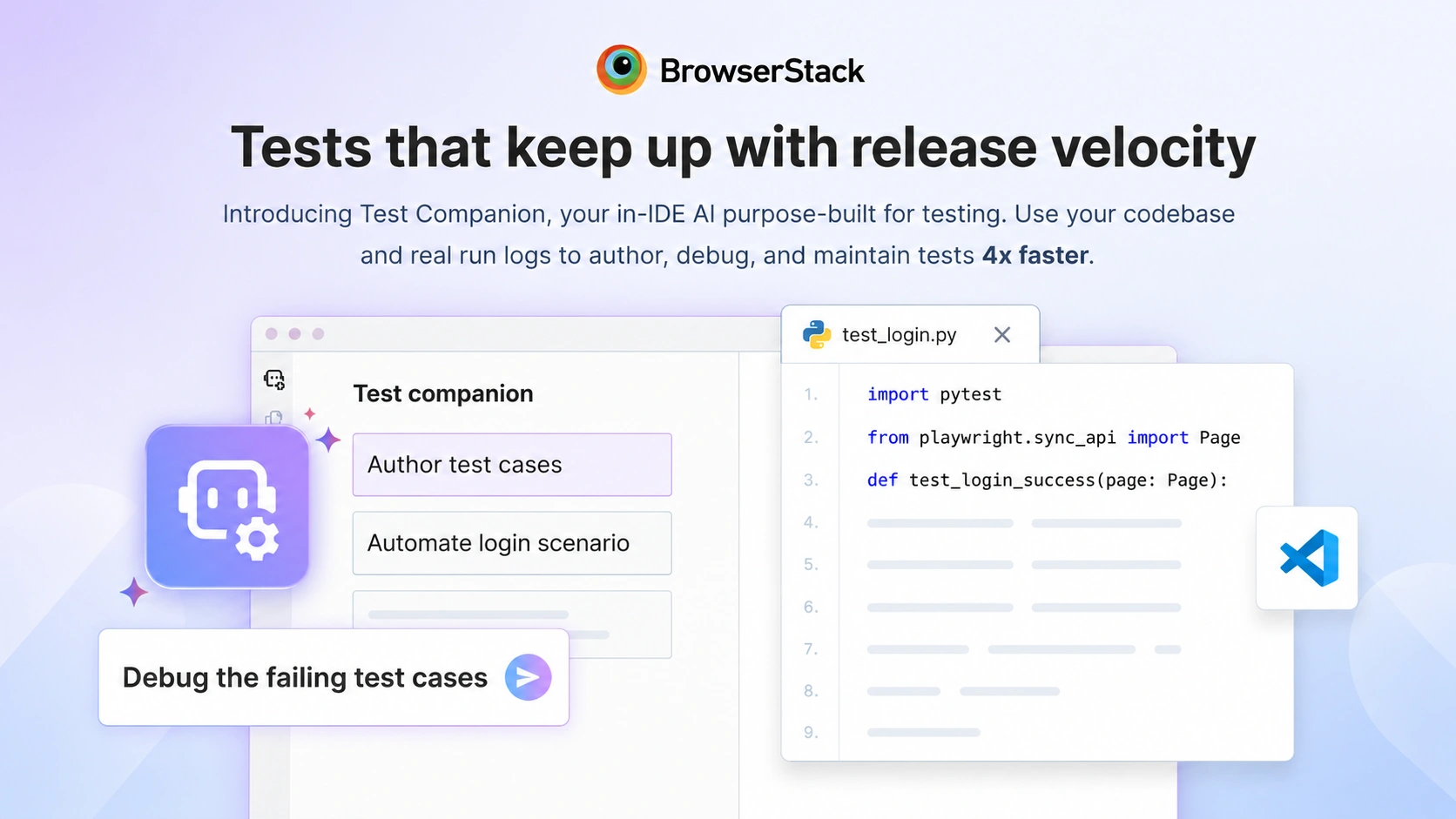
BrowserStack has introduced an AI-powered testing assistant that operates inside development environments, reflecting a growing effort to streamline software testing as AI accelerates code generation.
BrowserStack has launched Test Companion, an AI-powered testing assistant that integrates directly into popular integrated development environments (IDEs) to support software testing throughout the development process. The release addresses a challenge that has become increasingly visible as AI coding tools gain widespread adoption: while developers can generate software more quickly, testing and quality assurance have not advanced at the same pace. As organizations seek to shorten development cycles without compromising reliability, testing is becoming a key area for AI-driven innovation.
The rapid adoption of AI coding assistants has significantly increased software development productivity, but writing code is only one stage of the software lifecycle. Applications must still be tested across different browsers, devices, and operating systems before they are ready for release. Creating, maintaining, and updating automated tests has traditionally required considerable manual effort, particularly as applications evolve. This has prompted technology companies to explore AI systems capable of assisting not only with code generation but also with the ongoing work of validating and maintaining software quality.
According to BrowserStack, Test Companion supports the full testing lifecycle from within the IDE, including generating test cases, writing automation scripts, executing tests, debugging failures, and maintaining existing test suites. The company says the assistant works with established testing frameworks such as Playwright, Selenium, Cypress, Appium, WebdriverIO, and TestNG while integrating with tools used for issue tracking and test management. BrowserStack also states that the platform can validate software across more than 30,000 real devices and browsers and includes specialized AI capabilities for areas such as visual testing, accessibility testing, root-cause analysis, and automated test maintenance. The tool is available for several widely used development environments, including Visual Studio Code, JetBrains IDEs, Cursor, and Antigravity.
The announcement reflects a broader trend toward embedding AI directly into professional software development workflows rather than offering it as a standalone service. Developers increasingly expect AI tools to understand existing codebases, adapt to established engineering practices, and operate within familiar environments without disrupting established processes. For organizations, this integrated approach may help improve both productivity and consistency across development teams.
BrowserStack’s latest release highlights how artificial intelligence is expanding beyond code generation into software quality assurance. As development teams continue adopting AI throughout the engineering process, tools that support testing, debugging, and long-term maintenance are likely to play an increasingly important role in helping faster software development translate into more reliable product releases.