A Harris Poll study with Ruth AI finds broad willingness to delegate job hunting and salary negotiations to AI, even as awareness of potential bias in career advice remains limited.
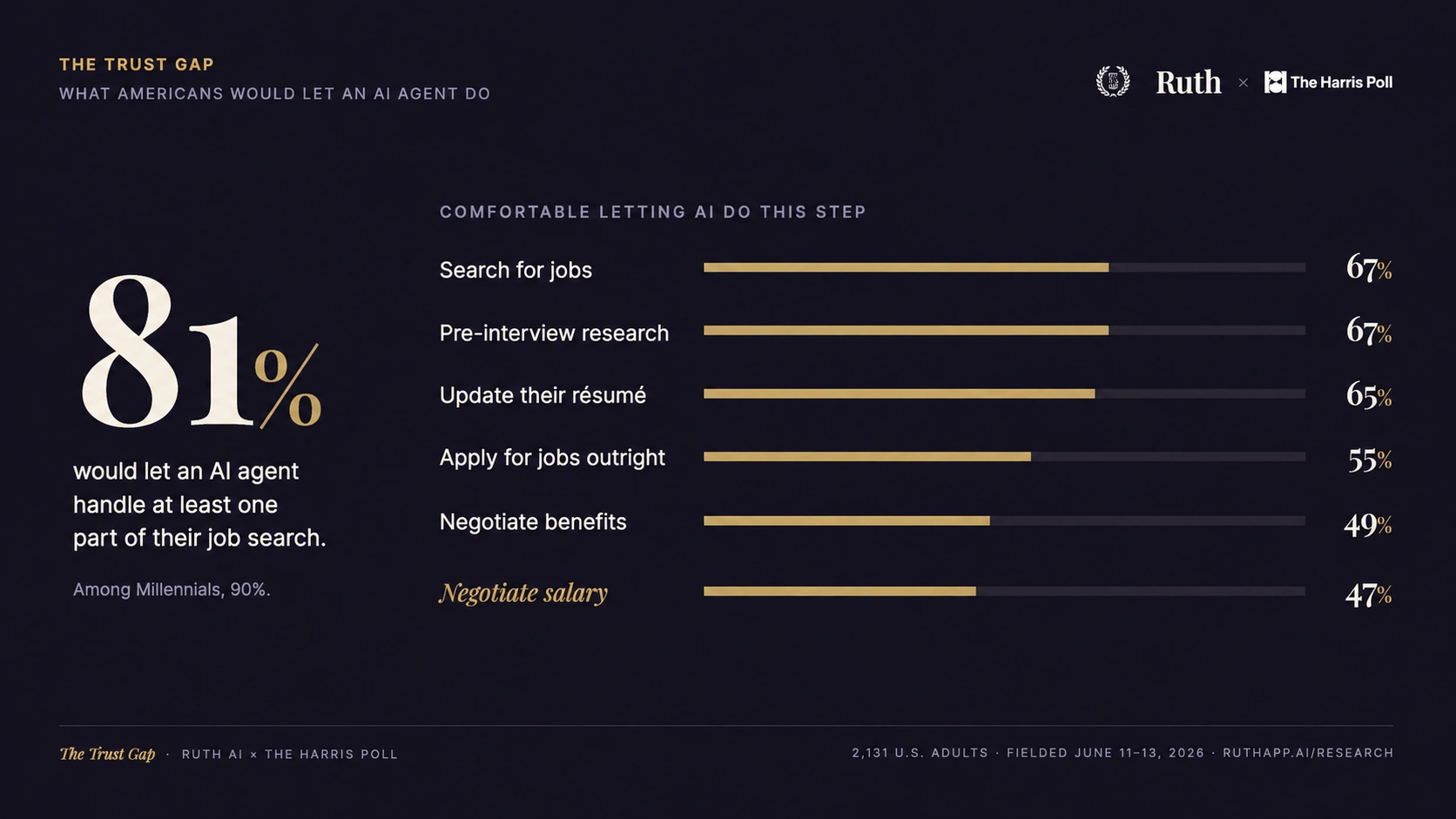
Ruth AI and The Harris Poll have found that Americans are increasingly willing to move beyond asking artificial intelligence for workplace advice and allow it to take action on their behalf. In a June 2026 survey of 2,131 U.S. adults, 81% said they would be comfortable letting an AI agent handle at least one part of their job search, suggesting that automation could become a more active participant in how people navigate employment.
That openness extends across several consequential tasks. Sixty-seven percent of respondents would allow AI to search for jobs or conduct pre-interview research, 65% would use it to update a resume and 55% would permit it to submit job applications. More strikingly, 49% said they would let AI negotiate benefits, while 47% would entrust the technology with salary negotiations, decisions that can have lasting financial implications.
The findings also show that AI is already becoming a common source of professional guidance. Forty-five percent of Americans surveyed have used platforms such as ChatGPT, Claude or Gemini for career or work-related advice, rising to 66% among Millennials and 63% among Gen Z. One-third of adults have sought AI guidance about workplace financial matters including salaries, raises, bonuses or pay negotiations.
Yet the survey identifies a notable gap between adoption and awareness of AI’s limitations. Seventy-six percent of respondents had never heard that independent research has found AI systems can produce biased career and salary guidance, while 72% agreed that AI can sound confident even when its advice is incorrect. The survey itself did not test AI systems for bias, instead referencing separate academic research on the issue.
The results capture an emerging tension as AI tools become more capable of acting rather than simply advising. Workers appear increasingly prepared to delegate time-consuming parts of employment searches, but decisions involving applications, compensation and career direction carry consequences that make reliability and transparency particularly important. As AI agents become more deeply embedded in professional life, the question may shift from whether workers will use them to how much judgment they are willing to surrender along the way.