Research from Hanyang University suggests that making environmental costs visible could influence how travellers conserve resources during hotel and short-term rental stays.
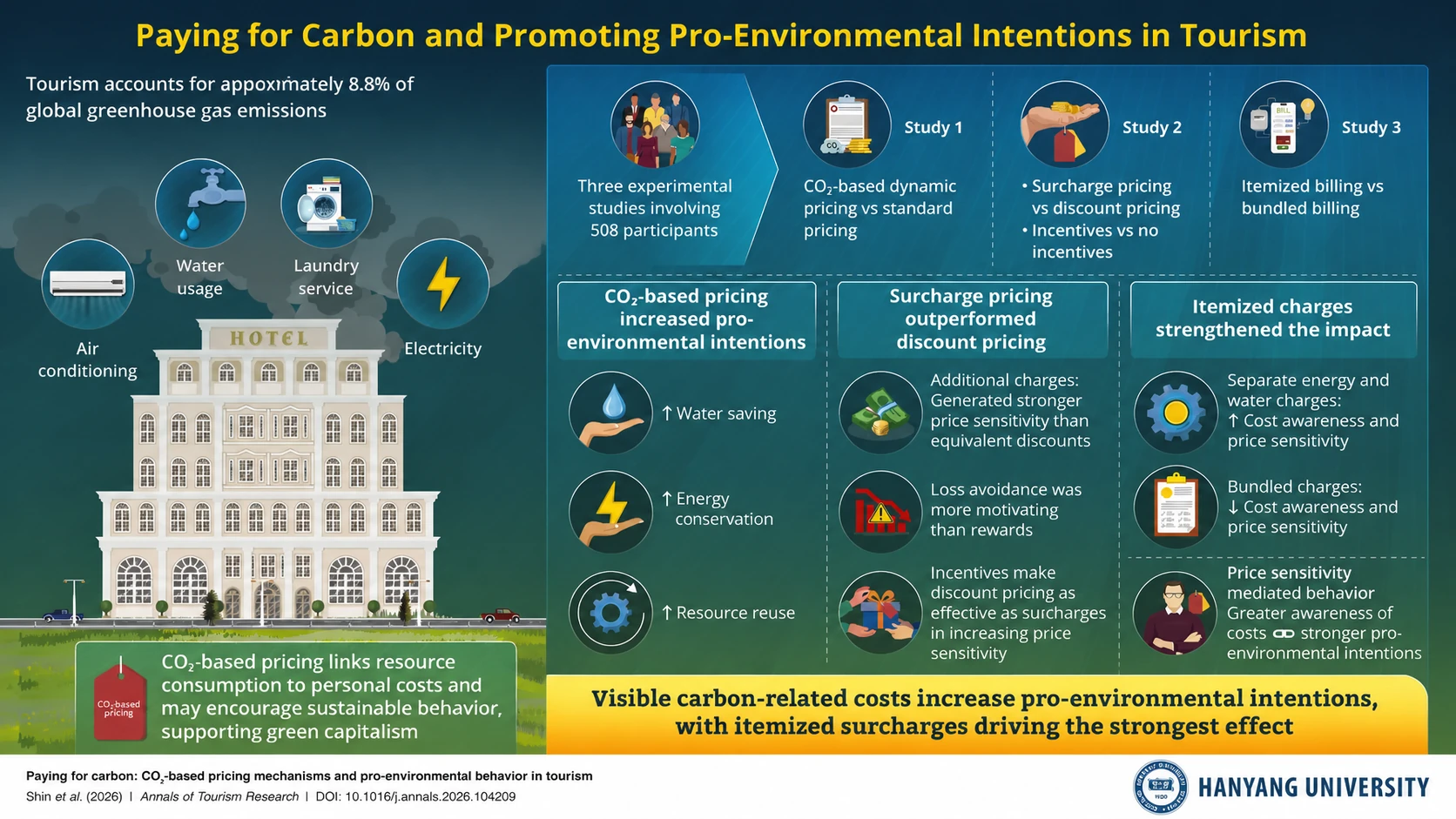
Hanyang University researchers have found that linking accommodation prices to guests’ resource consumption can strengthen intentions to conserve energy and water. The study, led by Professor Hakseung Shin of the university’s School of Tourism, examined carbon-based pricing in hotel and short-term rental booking scenarios. Its findings suggest that the way sustainability costs are presented may matter as much as the incentive itself, giving tourism businesses a more specific mechanism to test than general appeals to responsible behaviour.
The research addresses a persistent challenge in tourism: hotels have traditionally encouraged towel reuse, reduced linen changes and lower energy use through voluntary programmes, while the sector remains a significant source of carbon emissions. The researchers examined whether tying the environmental impact of a stay directly to its price could change travellers’ stated willingness to make lower-impact choices. The focus was therefore not on broad environmental messaging, but on how pricing design might shape decisions during an accommodation stay.
Across three experiments using realistic booking scenarios, the team tested different approaches to carbon-linked pricing. The release reports that participants showed stronger intentions to conserve resources when wasteful consumption could increase their costs, while discount-based incentives produced comparable conservation intentions in some comparisons. The strongest responses came when higher resource use generated an additional charge rather than an equivalent discount, and when environmental fees were itemised separately instead of bundled into one total price.
That distinction gives the findings a practical implication for hotels, short-term rental operators and tourism platforms. A separate charge for electricity, water, heating, cooling or linen services makes the environmental consequence of consumption more visible, according to the study, while a surcharge may create greater price sensitivity than a reward for restraint. Professor Shin characterised the approach as green capitalism, arguing that market incentives can align ecological objectives with everyday purchasing decisions.
The researchers also caution that the evidence has limits: the experiments used hypothetical booking situations and measured behavioural intentions rather than actual conduct. They said future research will be needed to establish whether the effects translate into real-world tourism settings, while advances in smart technology and carbon tracking could make personalised pricing more feasible over the next five to 10 years. For Hanyang University, the study places pricing visibility at the centre of a narrower question for the tourism industry: whether travellers respond differently when the environmental cost of a stay is made explicit.