A new Bitcoin Daily study argues that shrinking price swings, rather than broken market cycles, explain why several widely followed indicators failed to signal Bitcoin’s 2025 peak.
Bitcoin Daily has published research offering an explanation for why several historically watched Bitcoin market indicators failed to signal the cryptocurrency’s October 2025 peak near $126,000. The study, written by founder and data scientist Josh Molnar, argues that measures including MVRV and the Mayer Multiple have become less useful as fixed thresholds because the magnitude of Bitcoin’s cycle-to-cycle price movements has steadily declined.
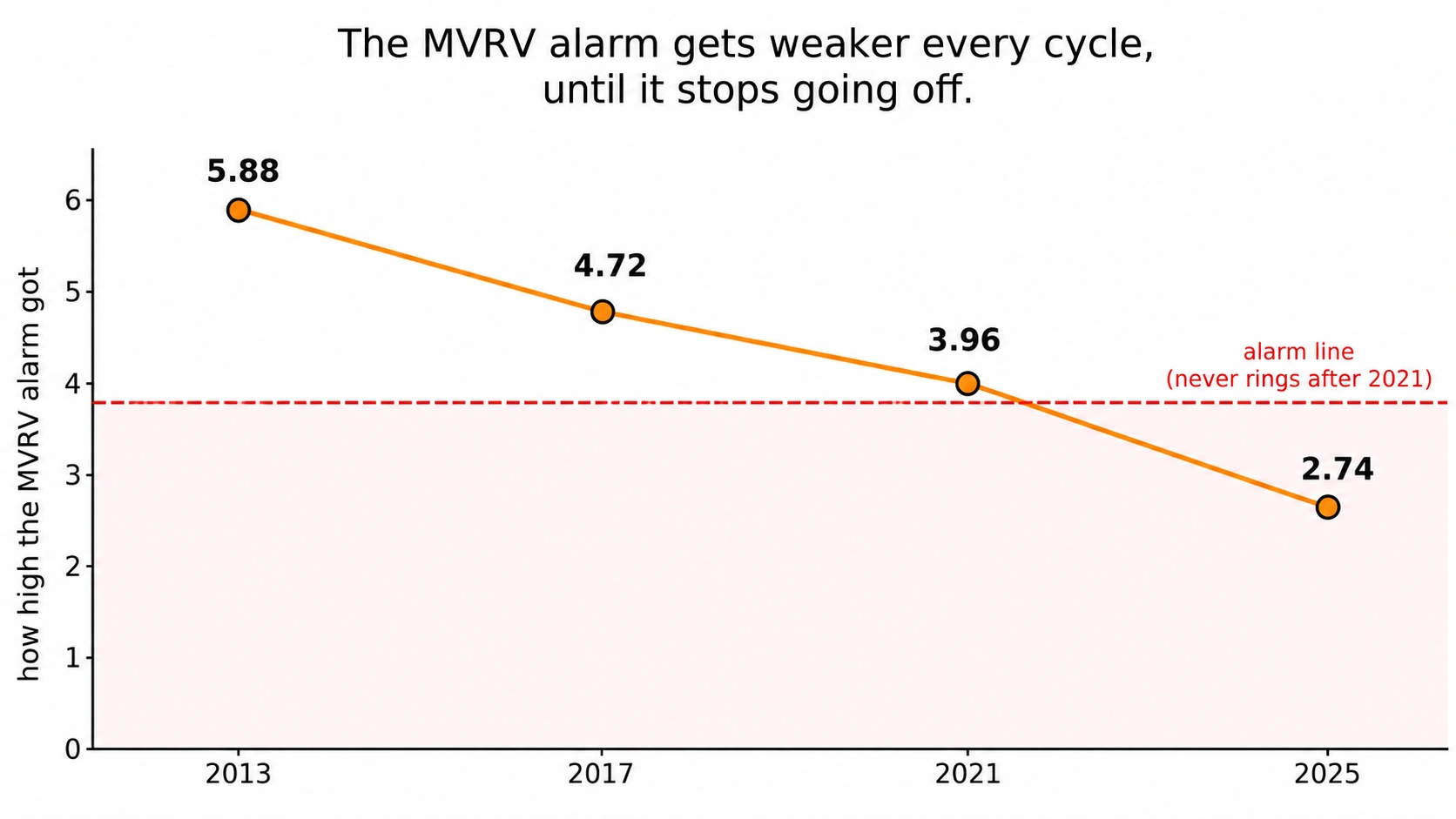
The distinction centers on amplitude versus timing. According to the paper, MVRV peaks fell from 5.88 to 4.72, 3.96 and finally 2.74 across four cycles, while the Mayer Multiple declined from 8.26 to 1.52. If indicators depend on reaching predetermined levels, smaller market swings can prevent those thresholds from being crossed even when Bitcoin is approaching a cyclical high.
Molnar’s research argues that timing patterns have been more persistent. The study finds that previous cycle tops have occurred between 525 and 546 days after Bitcoin halvings, including the October 2025 high following the April 2024 halving. In simulations of 10,000 random markets, none produced clustering as tight under the paper’s primary statistical test, while a more conservative version placed the probability at roughly one in 1,000.
That historical pattern forms the basis for a more consequential claim: the study identifies October 5 through November 16, 2026 as a potential window for Bitcoin’s next cycle bottom. It also projects that the subsequent cycle top could arrive 525 to 546 days after the next halving, currently pointing toward late 2029. These remain forecasts derived from historical relationships, however, and their usefulness will ultimately depend on whether those relationships continue.
Molnar previously predicted in January 2025 that Bitcoin would reach its cycle high that October, which aligned with the eventual October 6 peak. His accompanying price forecast of $150,000 to $200,000 did not, with Bitcoin instead topping near $126,000. That split between accurate timing and inaccurate magnitude neatly illustrates the study’s central argument, while also underscoring why historical patterns should be treated as hypotheses to test rather than guarantees about future markets.