Lingokids research suggests parents are increasingly concerned about the quality and safety of children’s digital content, shifting attention from screen-time limits toward stronger curation.
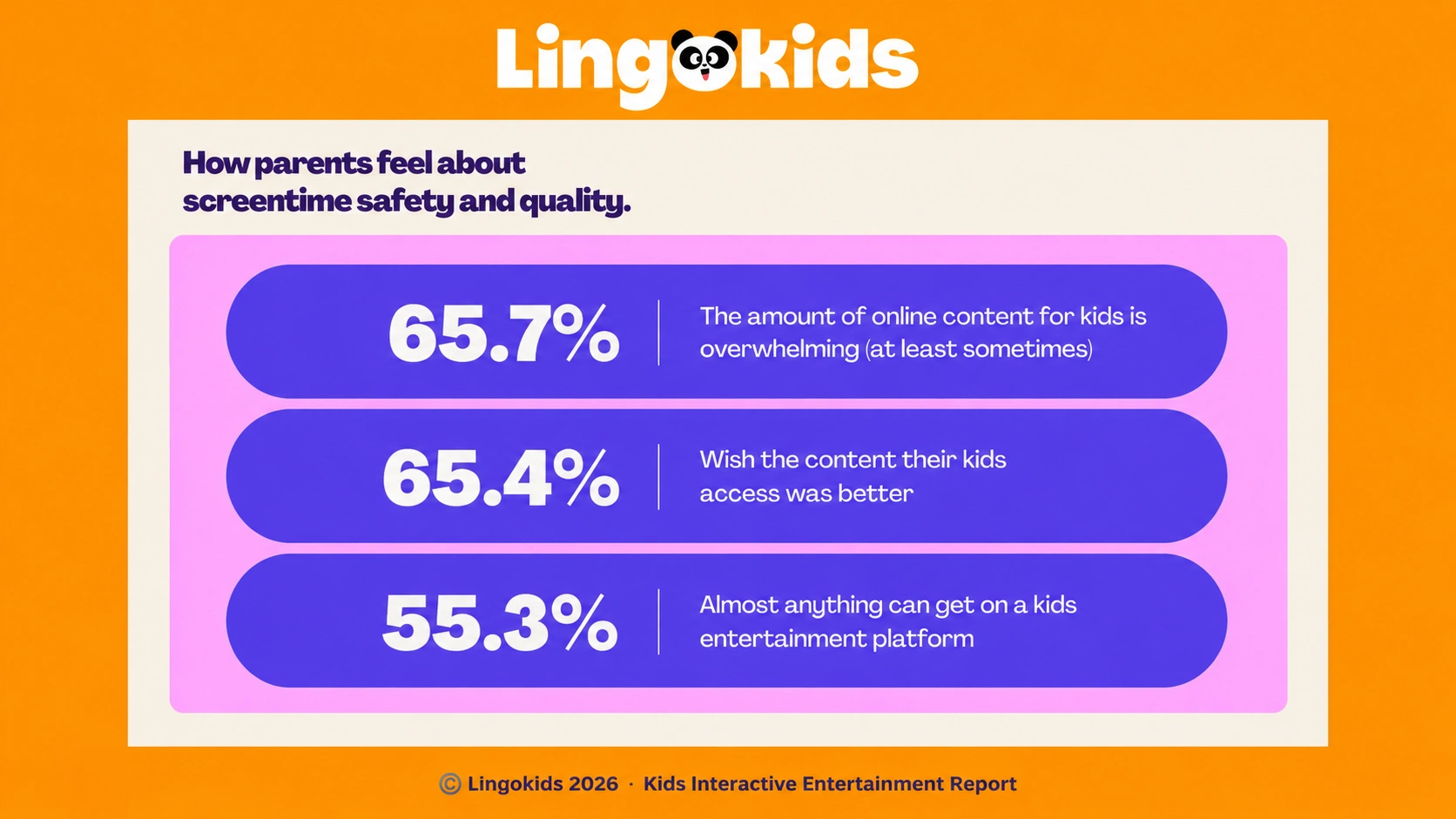
Lingokids has released research pointing to growing unease among parents about the digital environments their young children use. Its Kids Interactive Entertainment Report, focused on children ages eight and under, found that 55.3% of parents believe “almost anything” can appear on a children’s entertainment platform, while 65.4% wish the content available to their children were better.
The findings suggest that the debate around children’s screen time may be becoming less about the number of minutes spent online and more about what fills those minutes. Nearly two-thirds of parents, 65.7%, said the volume of children’s content is overwhelming at least some of the time, while the report also states that half of parents say their children have encountered inappropriate material online. For families navigating large libraries and recommendation systems, greater choice can also mean more responsibility for monitoring what appears next.
That concern appears to be influencing how some parents set boundaries. Rather than imposing limits solely by time, families may increasingly distinguish between individual apps and platforms based on the quality and appropriateness of their content. The report identifies safety as parents’ leading priority and highlights frustration with environments where age-appropriate material can appear alongside content parents consider unsuitable.
Lingokids predicts that these concerns will encourage families to move away from open platforms and toward more curated digital environments by 2028. That forecast should be viewed as the company’s interpretation of current attitudes rather than a certainty, but the underlying survey results point to a broader question for children’s media: whether platforms can maintain parental confidence as their libraries and recommendation systems expand.
The distinction matters because children’s digital entertainment is no longer simply a question of whether screens are present in family life. Parents are also evaluating who selects the content, how easily unsuitable material can surface and whether features such as autoplay encourage children to move beyond what adults originally intended them to watch. As those concerns grow, curation and platform design may become as important to parents as traditional screen-time limits.