MathGPT.ai has introduced an AI grader for handwritten mathematics assignments, reflecting how higher education is exploring automation while preserving process-based assessment and academic integrity.
MathGPT.ai has introduced an AI Step-by-Step Grader designed to evaluate handwritten mathematics assignments in higher education. Developed by Got It, Inc., the tool analyzes paper-based student work, awards partial credit based on the reasoning shown, and provides detailed feedback on submitted solutions. The release comes as colleges and universities continue to reassess how artificial intelligence fits into teaching, particularly in subjects where demonstrating the problem-solving process is often as important as reaching the correct answer.
The growing availability of generative AI has complicated traditional approaches to homework and assessment. In mathematics, instructors have become increasingly concerned that AI tools can produce correct answers without revealing whether students genuinely understand the underlying concepts. As a result, some educators have returned to handwritten assignments and in-class problem solving, methods that emphasize reasoning but also increase the time required for grading. This has created demand for technologies that can support process-based evaluation without adding to faculty workloads.
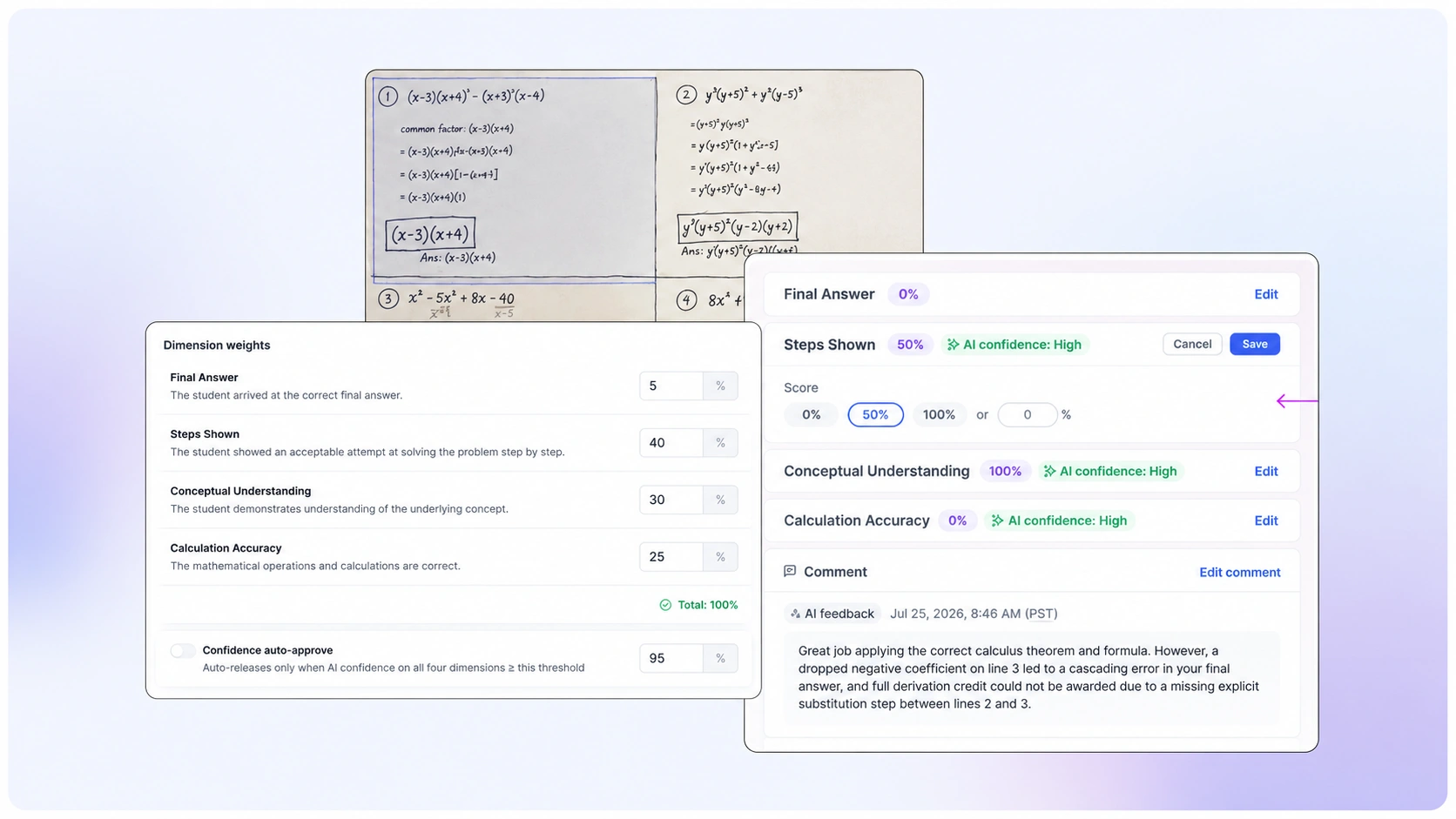
According to MathGPT.ai, the new grading system processes handwritten mathematical solutions and proofs, evaluating each submission using a rubric that instructors can adjust to reflect different grading priorities. Rather than assessing only the final answer, the platform is designed to recognize intermediate steps and assign partial credit when students demonstrate correct reasoning despite arriving at an incorrect conclusion. The company says the system also provides immediate feedback that highlights calculation errors and areas for improvement, reducing the need for follow-up clarification outside the classroom. MathGPT.ai states that its platform is currently used across 150 higher education institutions, supporting more than 1,200 courses.
The announcement reflects a broader shift in educational technology toward AI systems that complement, rather than replace, instructor oversight. Instead of automating final grading decisions entirely, many institutions are exploring tools that reduce repetitive administrative work while allowing educators to retain control over evaluation standards. This approach may prove particularly valuable in mathematics, where grading often involves interpreting a student’s reasoning as much as verifying the correctness of an answer.
MathGPT.ai’s latest release illustrates how artificial intelligence is being applied to longstanding challenges in higher education rather than simply introducing new digital experiences. As educators continue balancing efficiency with academic integrity, tools that support handwritten, process-oriented assessment could become an increasingly important part of classroom practice.