Dario Costa’s aircraft manoeuvre on a moving freight train gives Red Bull a new piece of high-risk content while highlighting the technical demands behind its spectacle-led marketing.
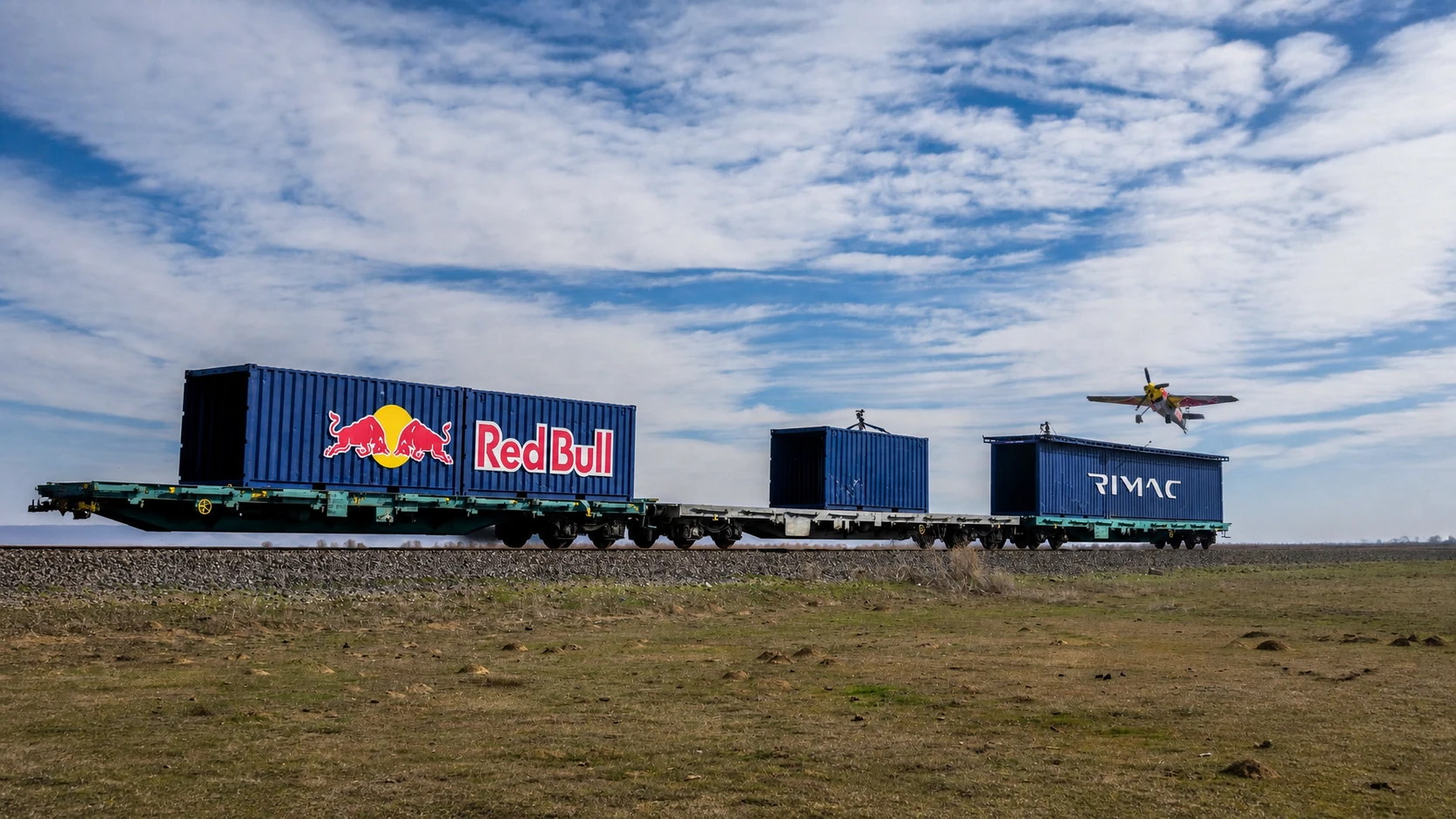
Red Bull athlete Dario Costa completed what the company describes as the world’s first combined aircraft landing and vertical take-off from a moving freight train in Afyonkarahisar, Türkiye. On February 15, 2026, Costa landed a Zivko Edge 540 on the ninth freight container while the train travelled at 120 kilometres per hour, then took off vertically from the same container. The stunt extends Red Bull’s long-running use of athletic performance as a vehicle for branded storytelling, but its defining feature is the precision required to make the image possible.
Costa reduced the aircraft’s speed to a near-minimum controllable 87 kilometres per hour, or 47 knots, to match the train’s operating speed of 120 kilometres per hour, or 65 knots. The complete sequence, covering the approach, blind landing and take-off, took place within a 50-second window along a 2.5-kilometre section of track. Because of the aircraft’s position and the train’s dimensions, the landing platform was outside Costa’s view during the final approach.
The aircraft was a single-seat, piston-engine, mid-wing Zivko Edge 540 with a 400-horsepower engine, a 7.5-metre wingspan and a seven-metre length. The source material states that no major structural changes were made to the aircraft, although its configuration was adapted for lower-speed flight with two special strakes and six small vortex generators. Those changes were intended to support control during a manoeuvre shaped by the moving train’s turbulence and unstable airflow.
Preparation combined aerodynamic analysis, simulation and flight training with cognitive time-and-motion anticipation exercises at the Red Bull Athlete Performance Centre in Thalgau, Austria. A three-day moving-platform scenario in Pula, Croatia, was also used to improve alignment and reaction time. Costa characterised the project as one of the most demanding of his career, with the blind landing requiring concentration on both cognitive and flying skills, as well as precision, teamwork and trust.
For Red Bull, the performance demonstrates how technical preparation can give an extreme-sports narrative additional depth without displacing its visual immediacy. The moving train functions not simply as a backdrop but as a narrow, unstable landing surface that makes timing and control central to the story. The company frames the achievement as a milestone in applied aerodynamics and precision aviation, leaving Red Bull with another highly specific example of how engineered risk can be converted into global cultural content.