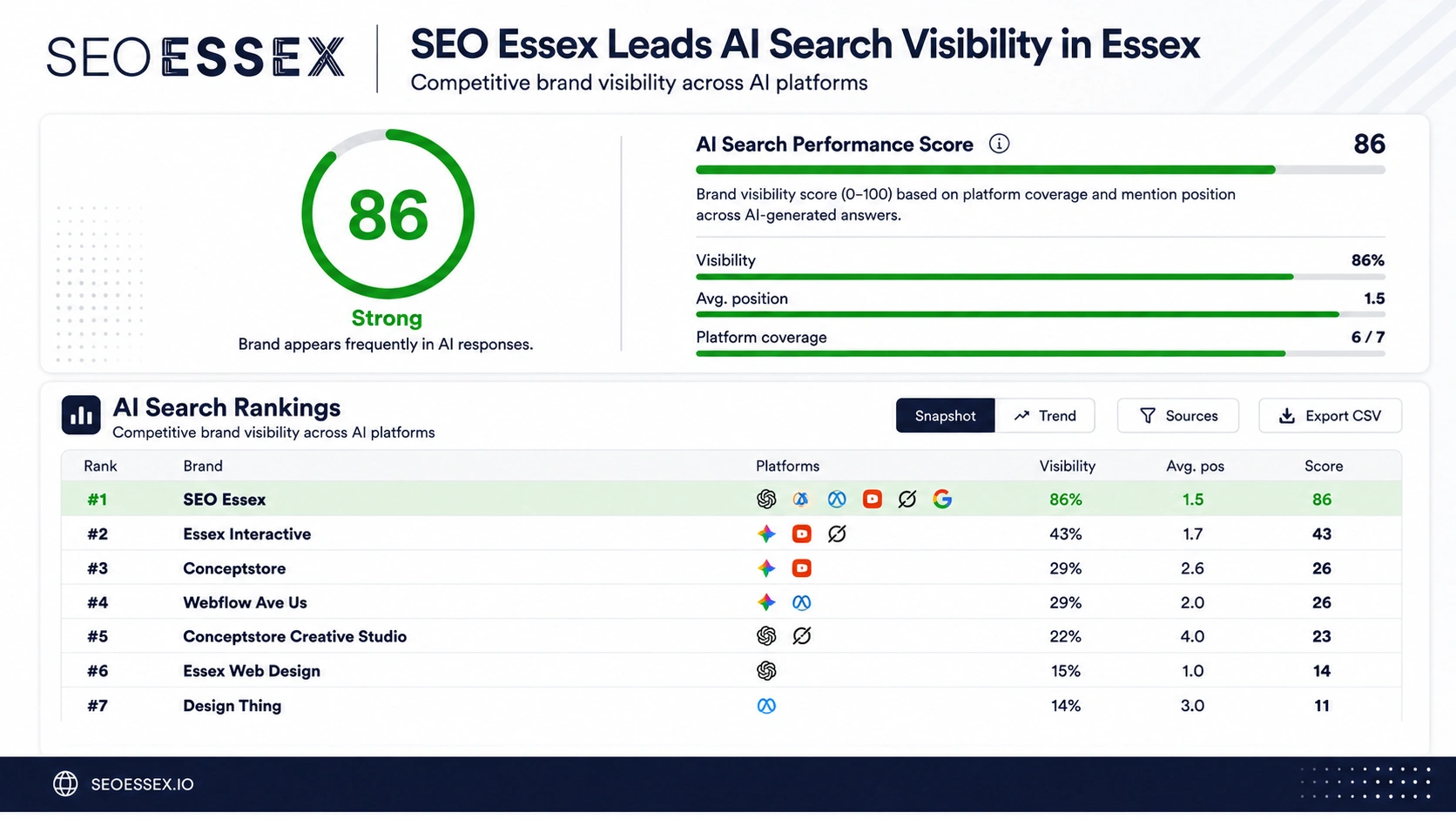
SEO Essex’s analysis suggests rising search activity is masking a decline in traditional clicks, pushing marketers to optimize content for AI-generated answers as well as rankings.
SEO Essex has released an analysis examining how AI-generated search summaries are changing the way businesses compete for online visibility. Drawing on public research rather than a proprietary survey, the analysis finds that 73% of marketers now prioritize content designed for inclusion in AI-generated answers, even as overall Google search activity continues to grow.
The tension is clearest in click-through behavior. Pew Research Center data cited in the analysis found that users clicked traditional search results during 8% of visits when an AI summary appeared, compared with 15% when one was absent; users were also more likely to end their browsing session after encountering an AI summary. For businesses accustomed to treating website traffic as a primary measure of search visibility, that shift complicates the traditional relationship between rankings, clicks and customer discovery.
Yet declining click-through rates do not necessarily mean people are searching less. The analysis points to growing use of conversational and highly specific queries, with roughly 60% of searches beginning with question words such as “who,” “when,” “what” or “why” producing an AI-generated summary. This creates a different challenge: companies increasingly need information that AI systems can identify, interpret and potentially surface without requiring users to visit the original website.
Businesses themselves are also adopting generative AI more widely. A U.S. Chamber of Commerce survey cited by SEO Essex found that 58% of small businesses used generative AI in 2025, up from 40% in 2024 and 23% in 2023, with applications ranging from content creation to SEO and review management.
For marketers, the emerging response is a move toward semantic clarity, structured information and stronger entity recognition rather than relying primarily on keyword targeting. Often described as Generative Engine Optimization, the approach reflects a broader change in search: being discoverable may increasingly mean being understood and cited by an AI system, even when that visibility produces fewer conventional website visits.