KXLM.ai’s new Enterprise Reasoning Platform coordinates multiple AI models to challenge assumptions and compare conclusions, targeting decisions where a single answer may not be enough.
Most generative AI tools are designed to return an answer from a single model, even when the underlying question involves uncertainty or competing interpretations. KXLM.ai is taking a different approach with its new Enterprise Reasoning Platform, which coordinates multiple frontier AI models to independently analyze questions, challenge competing hypotheses and refine conclusions through structured deliberation.
The premise is that complex business decisions may benefit from disagreement rather than another layer of confident-sounding automation. KXLM says its system is designed to expose assumptions, document differences between models and calibrate confidence before reaching a conclusion, giving users more visibility into how an answer develops. That approach is aimed at executives, investors, researchers and policymakers confronting decisions where the consequences of an incorrect judgment can be significant.
KXLM organizes the platform around several workflows. Its Orchestration system coordinates multiple AI models, while Prediction produces probabilistic forecasts and what the company calls “Checkable Calls” that can later be evaluated against actual events. Its Quantum AI Think Tank applies structured deliberation to strategic, scientific, financial and geopolitical questions, while an Arena feature currently in development is intended to compare competing strategies or AI systems under the same conditions.
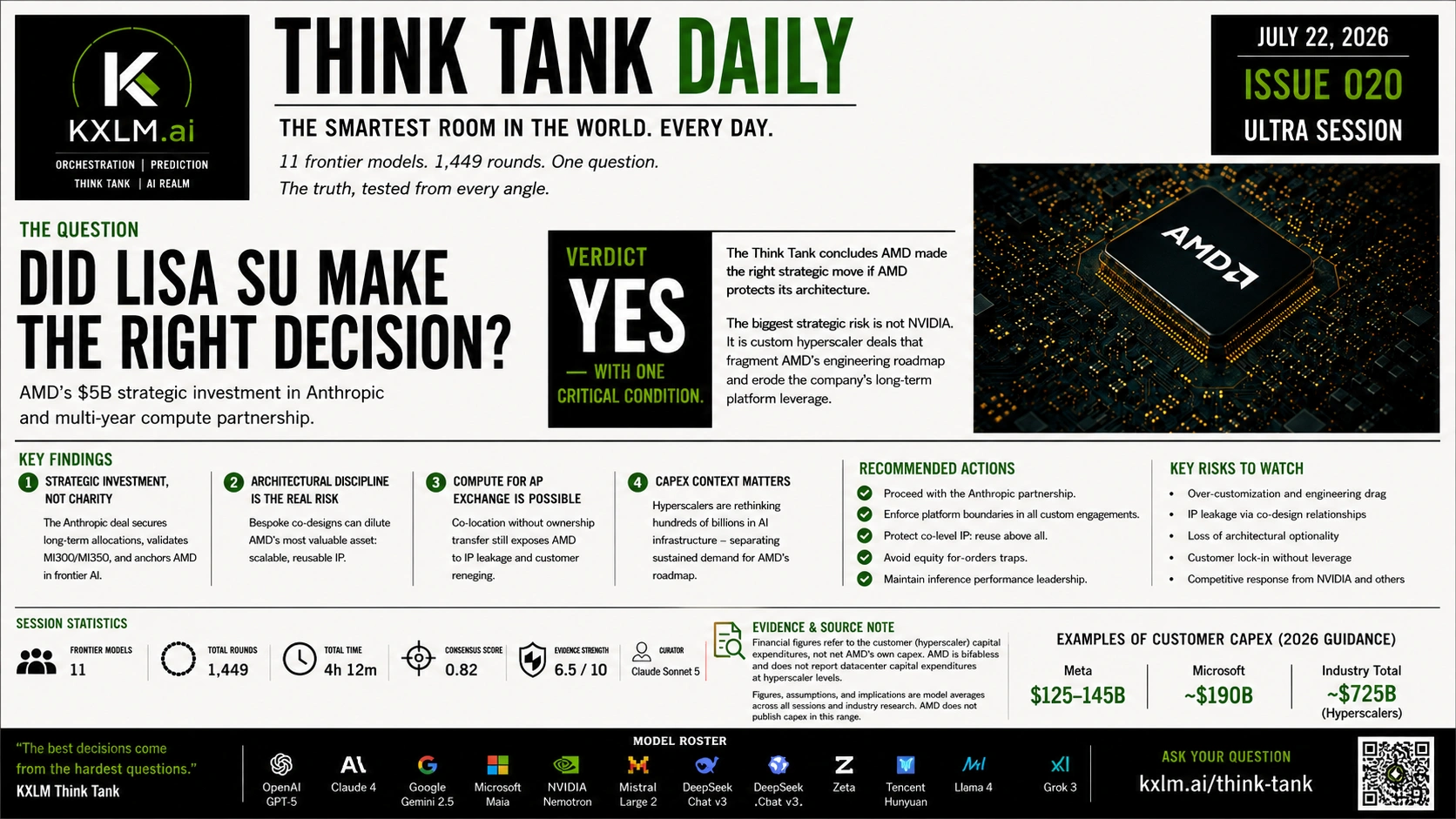
The company is also publishing Think Tank Daily, a research series intended to make its methodology visible outside enterprise deployments. Entries document competing hypotheses, disagreement, confidence levels, falsification criteria and recommended actions rather than presenting a single conclusion without qualification. KXLM says models participating in these deliberations can reject initial assumptions and revise their conclusions when stronger evidence emerges.
The broader idea reflects an unresolved challenge in enterprise AI: producing an answer quickly is different from producing one that decision-makers can scrutinize and trust. KXLM is currently working with selected enterprise partners while developing its platform and has filed provisional patent applications covering elements of its reasoning technology. Whether multi-model deliberation consistently produces better decisions remains to be demonstrated, but the platform points toward a notable direction for enterprise AI, where transparency about disagreement and uncertainty could become as important as the final answer itself.