A new benchmark from Startrise AI Labs suggests leading AI coding models are converging in performance, with cost, transparency, and reliability becoming key factors in enterprise adoption.
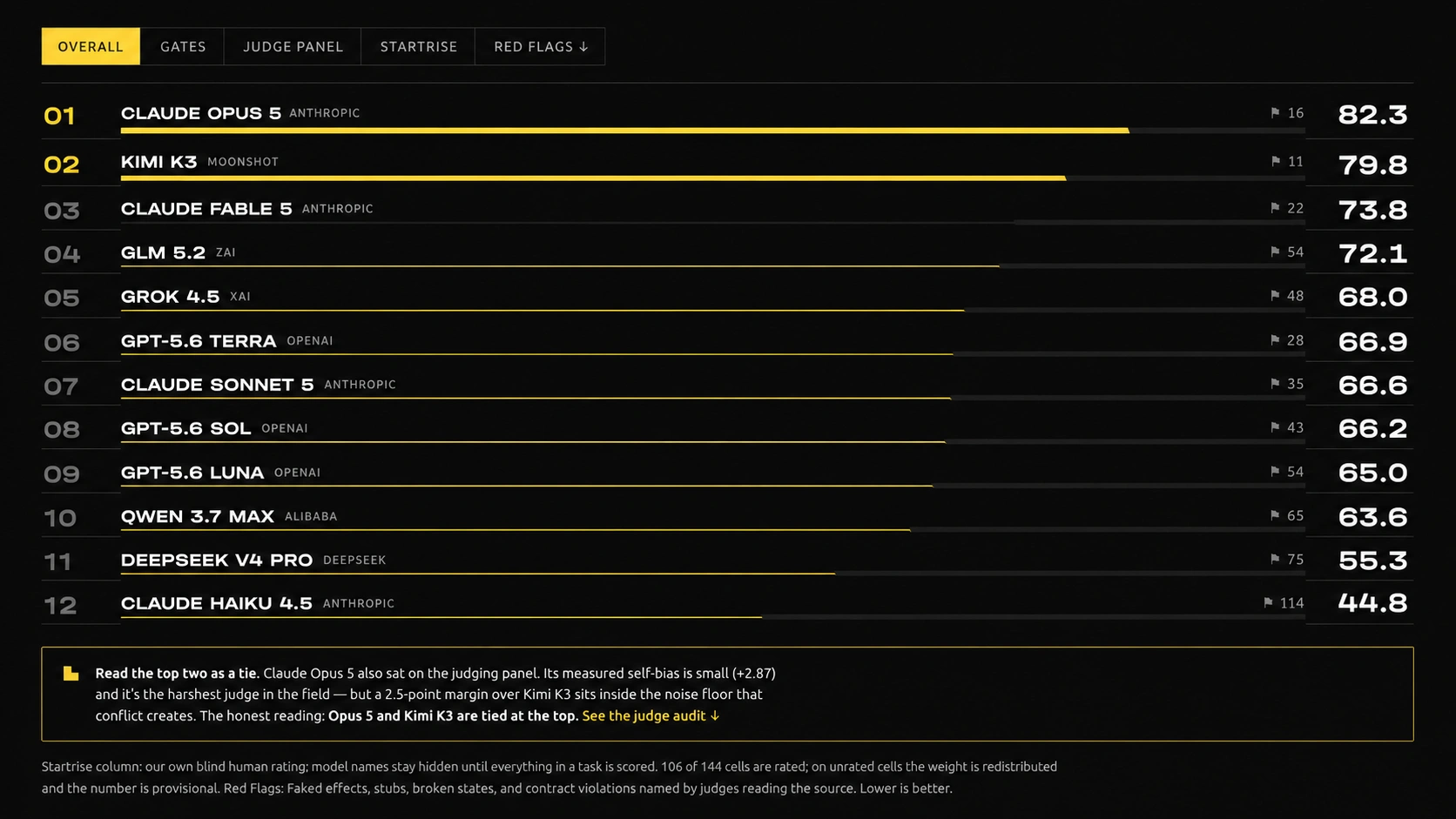
Startrise AI Labs has released the results of a new benchmark comparing twelve frontier AI models on real-world frontend engineering tasks, finding that performance differences among the leading systems are narrowing. The study ranked Anthropic’s Claude Opus 5 first, while Beijing-based Moonshot AI’s Kimi K3 finished within what the researchers described as the margin of measurement noise. The findings suggest that competition in AI coding is becoming increasingly global, with organizations evaluating models on practical outcomes rather than geographic origin alone.
The rapid evolution of coding assistants has shifted attention away from simple benchmark scores toward broader measures of real-world effectiveness. Enterprises increasingly want models that can complete production-ready work, follow instructions accurately, and deliver consistent results at a reasonable cost. As AI becomes a standard tool in software development, businesses are also weighing factors such as reliability, transparency, and operational efficiency alongside raw technical capability.
According to Startrise AI Labs, each model was asked to complete twelve production-style frontend development assignments without retries, follow-up prompts, or human assistance. The deliverables ranged from accessible interfaces and production email templates to WebGL shaders and a 3D game, with results evaluated through automated browser testing, blind judging panels, and blind human review. Beyond overall rankings, the study examined code integrity by identifying issues such as incomplete implementations and unmet requirements. It reported that Kimi K3 recorded fewer integrity flags than Claude Opus 5 while completing the benchmark at a substantially lower cost. The report also noted that several other Chinese-developed models performed competitively across measures of quality and efficiency, while OpenAI’s GPT-5.6 family placed in the middle of the overall rankings.
The benchmark reflects a broader shift in the AI industry, where discussions are moving beyond headline model releases toward measurable business value. For organizations selecting coding assistants, the practical questions increasingly concern cost-effectiveness, trustworthiness, and suitability for production work rather than simply identifying the highest-scoring model. Independent evaluations are becoming more significant as enterprises seek objective ways to compare rapidly evolving systems.
While the findings represent the conclusions of a single benchmark conducted by Startrise AI Labs, they underscore how quickly the competitive landscape is changing. As AI coding models continue to improve, purchasing decisions are likely to depend less on brand recognition and more on demonstrated performance, operational reliability, and total cost of deployment.