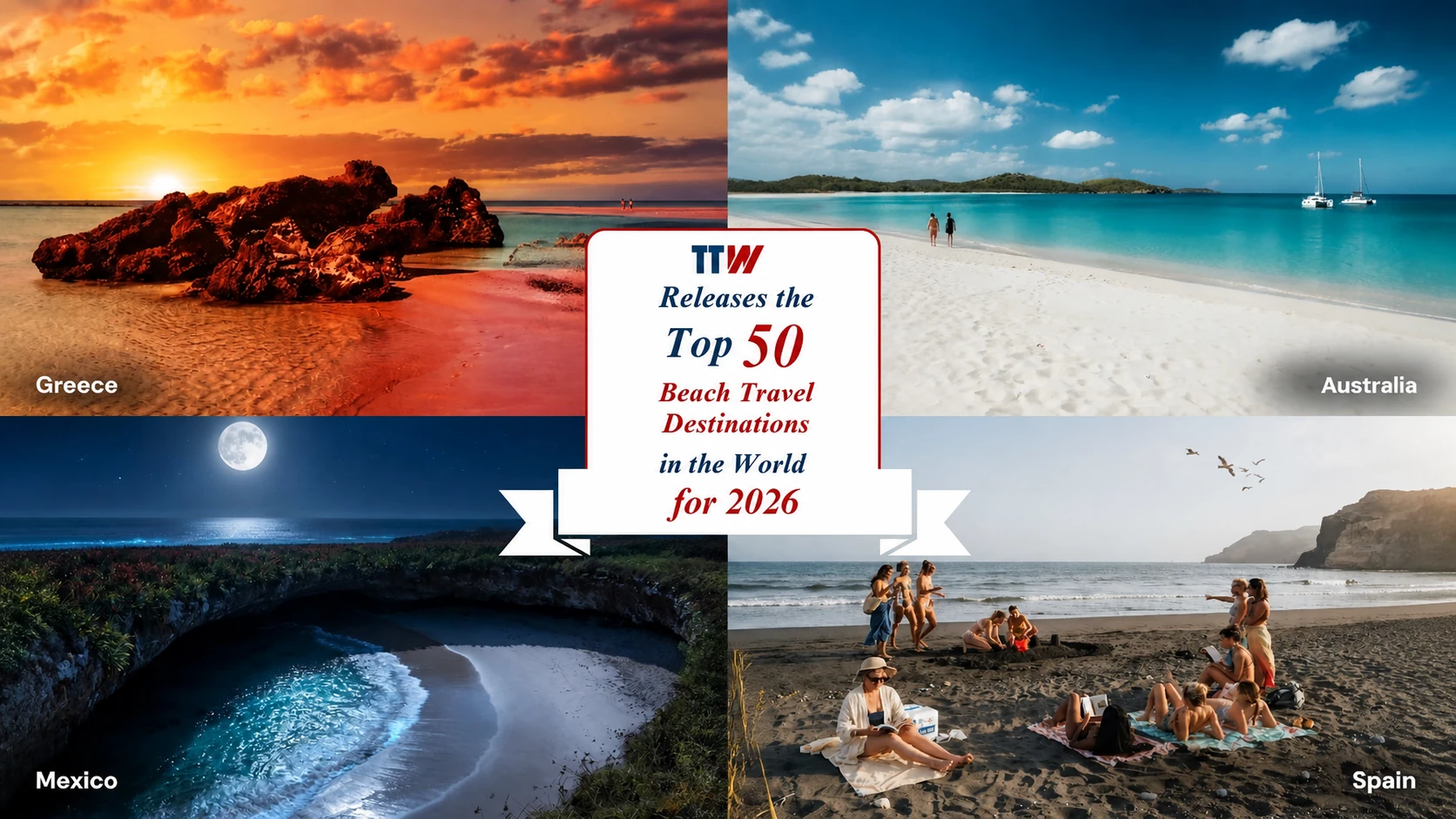
Travel And Tour World has released its 2026 ranking of 50 beach destinations, using a broad editorial framework that extends beyond scenery to sustainability and visitor experience.
Travel And Tour World (TTW) has revealed its Top 50 Beach Travel Destinations in the World for 2026, an editorial ranking that assesses countries across natural beauty, beach diversity, visitor experience, sustainability, marine ecosystems, accessibility, tourism infrastructure and cultural appeal. The release, issued on July 25, 2026, describes the list as a study of coastal tourism rather than a simple inventory of picturesque shorelines. TTW said the ranking is intended to highlight destinations offering a broad combination of environmental, cultural and practical qualities.
Greece occupies the top position, followed by Australia, Mexico, the Philippines, Thailand, Spain, Türkiye, the United States, Italy and Portugal. The wider list spans Mediterranean islands, Caribbean destinations, Pacific archipelagos, Indian Ocean retreats and Atlantic coastlines, reflecting the geographic range covered by the ranking. TTW said the selection was based on extensive global research and drew on the evaluation of more than 500 beaches.
The ranking includes 50 countries and territories, with destinations such as the Maldives, Seychelles, Brazil, Indonesia, Turks and Caicos Islands, the Bahamas, Mauritius, South Africa, India and Sri Lanka appearing in the upper half. The United States is ranked sixth, while France appears at 21st, Canada at 27th and Costa Rica at 29th. The release also provides detailed overviews and lists of 10 beaches for several of the highest-ranked countries, including Greece, Australia, Mexico and Spain.
The criteria indicate how TTW is framing the beach category for 2026: coastal appeal is presented as a combination of landscape, access, infrastructure, marine life, culture and responsible tourism. In comments included in the release, Anup Kumar Keshan, TTW’s founder and editor-in-chief, said travellers are seeking experiences that respect nature and local communities alongside attractive scenery. Those remarks position the ranking as an editorial interpretation of how coastal destinations can balance tourism activity with environmental stewardship.
For TTW, the ranking extends a series of destination-focused editorial lists covering areas such as food, hotels, medical tourism and amusement parks. Its beach report gives the organisation a structured way to compare a highly varied global category while retaining country-level rankings and destination-level detail. The restrained implication is that beach travel is being assessed through a wider lens, with the quality of the surrounding visitor experience carrying as much editorial weight as the coast itself.