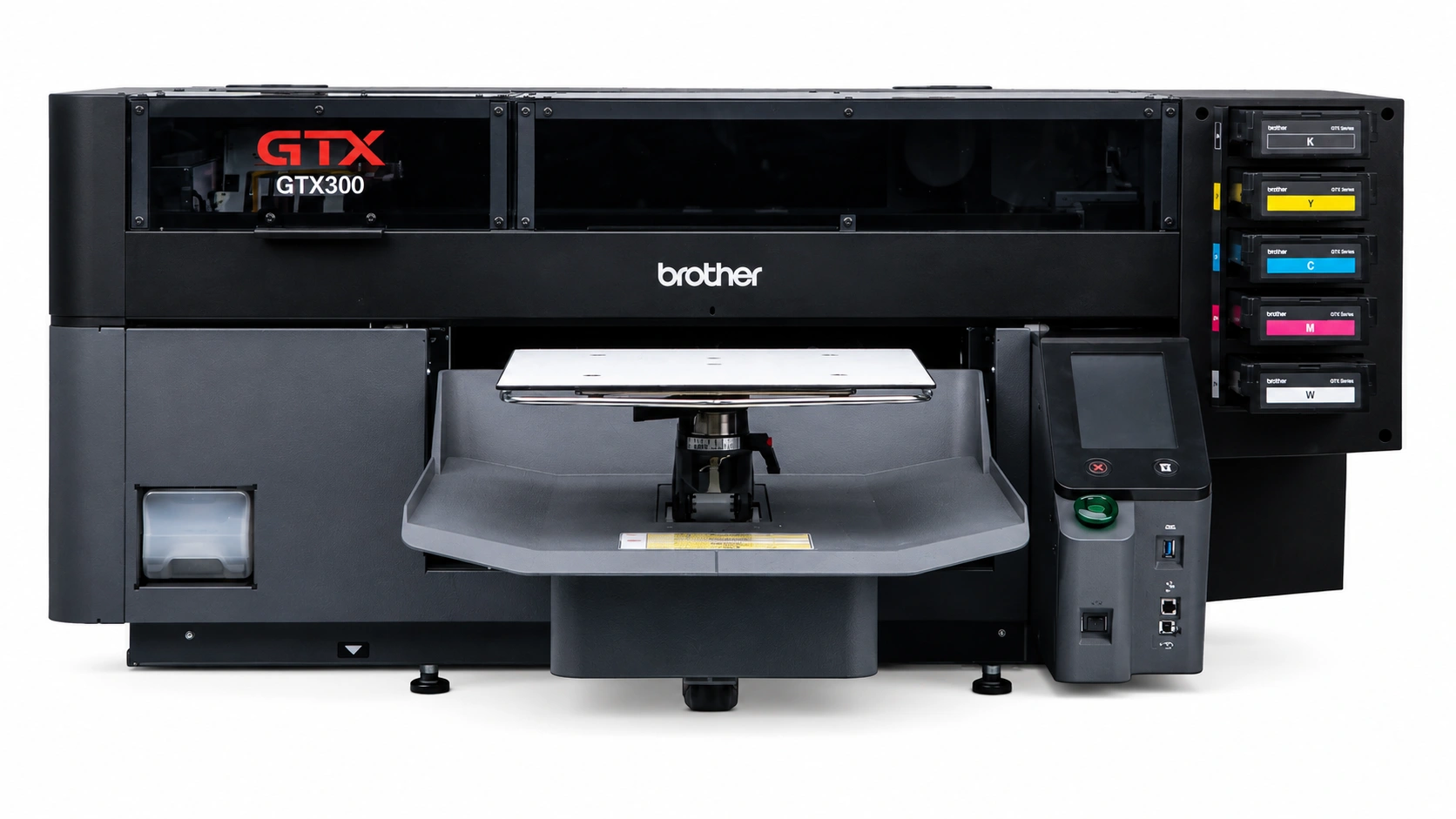
The GTX300 hybrid printer reflects growing demand for flexible apparel decoration, allowing print businesses to handle a wider variety of fabrics and customization projects with one machine.
Brother International Corporation has introduced the GTX300 Hybrid Garment Printer, a professional printing system that combines direct-to-garment (DTG) and direct-to-film (DTF) technologies in a single device. The launch reflects the changing needs of the apparel decoration industry, where businesses are increasingly expected to produce customized products across a broader range of materials without significantly expanding their equipment or production space. As demand for personalized apparel continues to grow, manufacturers are placing greater emphasis on versatility alongside print quality.
The apparel printing market has evolved considerably in recent years, driven by e-commerce, small-batch manufacturing, and on-demand production. Businesses that once specialized in a narrow range of garments now frequently receive orders spanning cotton T-shirts, polyester athletic wear, blended fabrics, and specialty items. Traditionally, accommodating these different materials often required separate printing systems, increasing both costs and operational complexity for small and medium-sized print shops.
Brother’s GTX300 is designed to address that challenge by allowing users to switch between DTG and DTF workflows within a single platform. Direct-to-garment printing remains well suited for natural fabrics, producing soft, detailed prints directly onto garments, while direct-to-film technology expands production possibilities to synthetic materials, performance apparel, oversized graphics, and more unconventional print locations. By integrating both capabilities into one system, the company is responding to a broader industry trend toward more adaptable production environments that can accommodate diverse customer requests without interrupting workflow.
The machine also reflects the increasing role of automation and usability in professional manufacturing equipment. Features such as automated maintenance, continuous white ink circulation, touchscreen controls, and integrated workflow software are intended to reduce routine maintenance while helping operators maintain consistent output. Compact equipment footprints have likewise become more important as many print businesses operate from smaller commercial spaces, educational settings, or workshops where available floor space is limited.
The GTX300 illustrates how innovation in apparel decoration is shifting from simply improving print performance to making production more flexible and efficient. Rather than requiring businesses to invest in multiple specialized systems, manufacturers are increasingly developing equipment capable of supporting varied workflows within a single platform. For apparel decorators navigating changing customer expectations and shorter production runs, that flexibility may prove as valuable as advances in print quality itself.