A new multi-bay charging platform points to a less visible challenge in autonomous mobility: the operational complexity of keeping large electric fleets running efficiently at scale
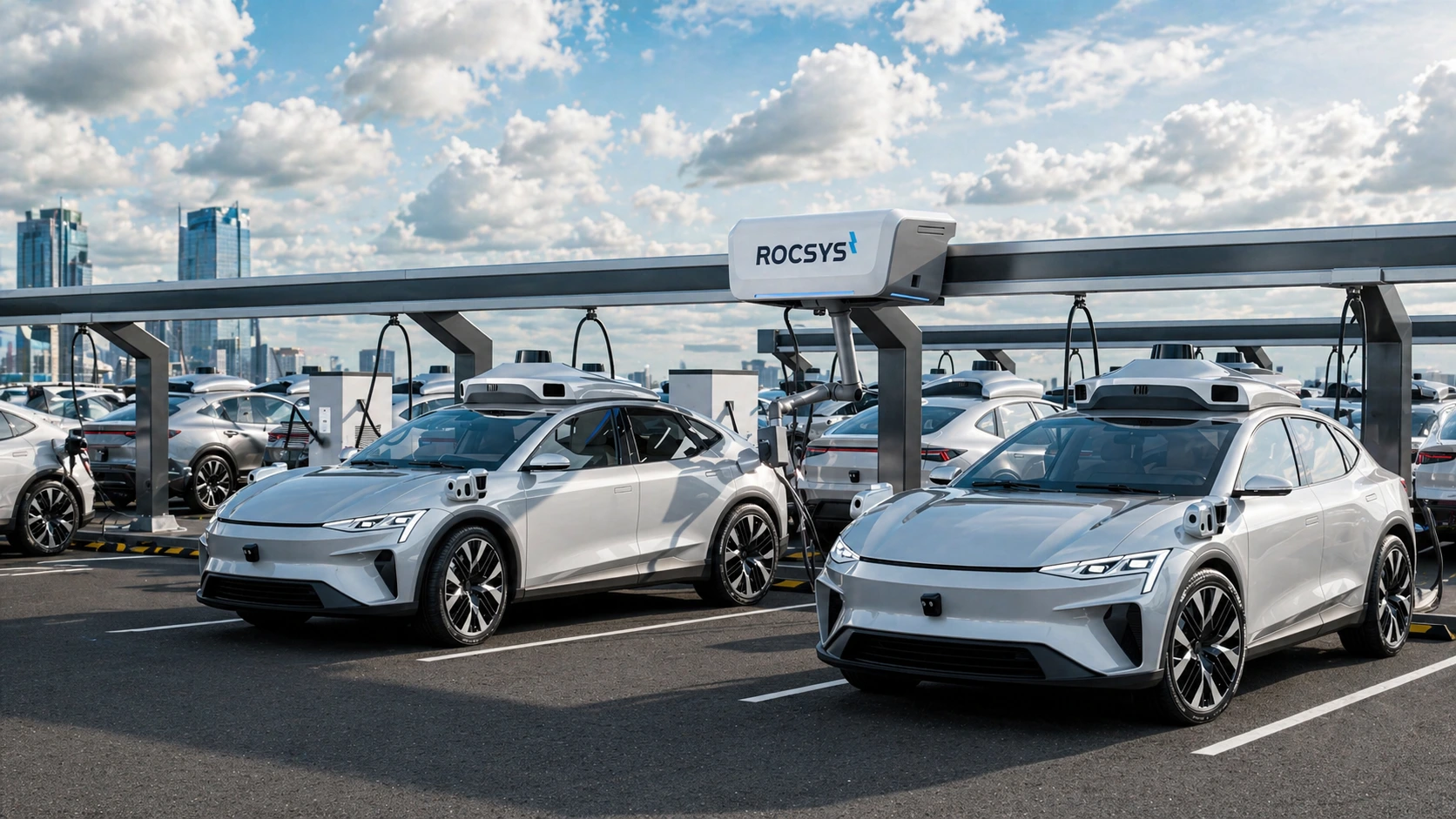
Rocsys has introduced the Rocsys M1, a hands-free charging system designed to serve multiple vehicles across robotaxi depots, while also announcing a $13 million Series A extension to support its expansion. The system is positioned as a response to a growing constraint in autonomous vehicle operations: the need to automate not just driving, but the infrastructure that supports it.
As electric and autonomous fleets scale, routine processes like charging—repeated thousands of times daily—become significant operational burdens. Manual plug-in systems introduce labor costs, safety risks, and downtime, factors that can limit fleet utilization even as vehicle technology itself advances. In this context, depot efficiency is emerging as a critical layer in the broader adoption of autonomous mobility.
The Rocsys M1 addresses this by using an overhead robotic system capable of servicing up to ten charging bays, allowing multiple vehicles to be connected without human intervention. Its compatibility across different vehicle types and charger formats reflects an industry still lacking standardization, where flexibility can determine how easily new infrastructure is deployed across mixed fleets.
Beyond the technical specifications, the development highlights a shift in how the industry defines autonomy. While much attention remains focused on self-driving capabilities, the ability to automate supporting processes—charging, cleaning, maintenance—may prove equally important in enabling continuous, real-world operations. Without these systems, autonomy risks stopping at the depot, where human intervention still dominates.
With pilot deployments underway and a broader rollout planned for 2027, Rocsys is entering a market expected to grow rapidly alongside robotaxi adoption. Its approach suggests that the next phase of innovation may be less about the vehicles themselves and more about the infrastructure that allows them to operate seamlessly at scale, turning isolated pilots into viable transportation networks.