Garmin’s latest update to Garmin Pilot reflects a broader effort to simplify aviation workflows by integrating air traffic control communications directly into digital flight planning tools.
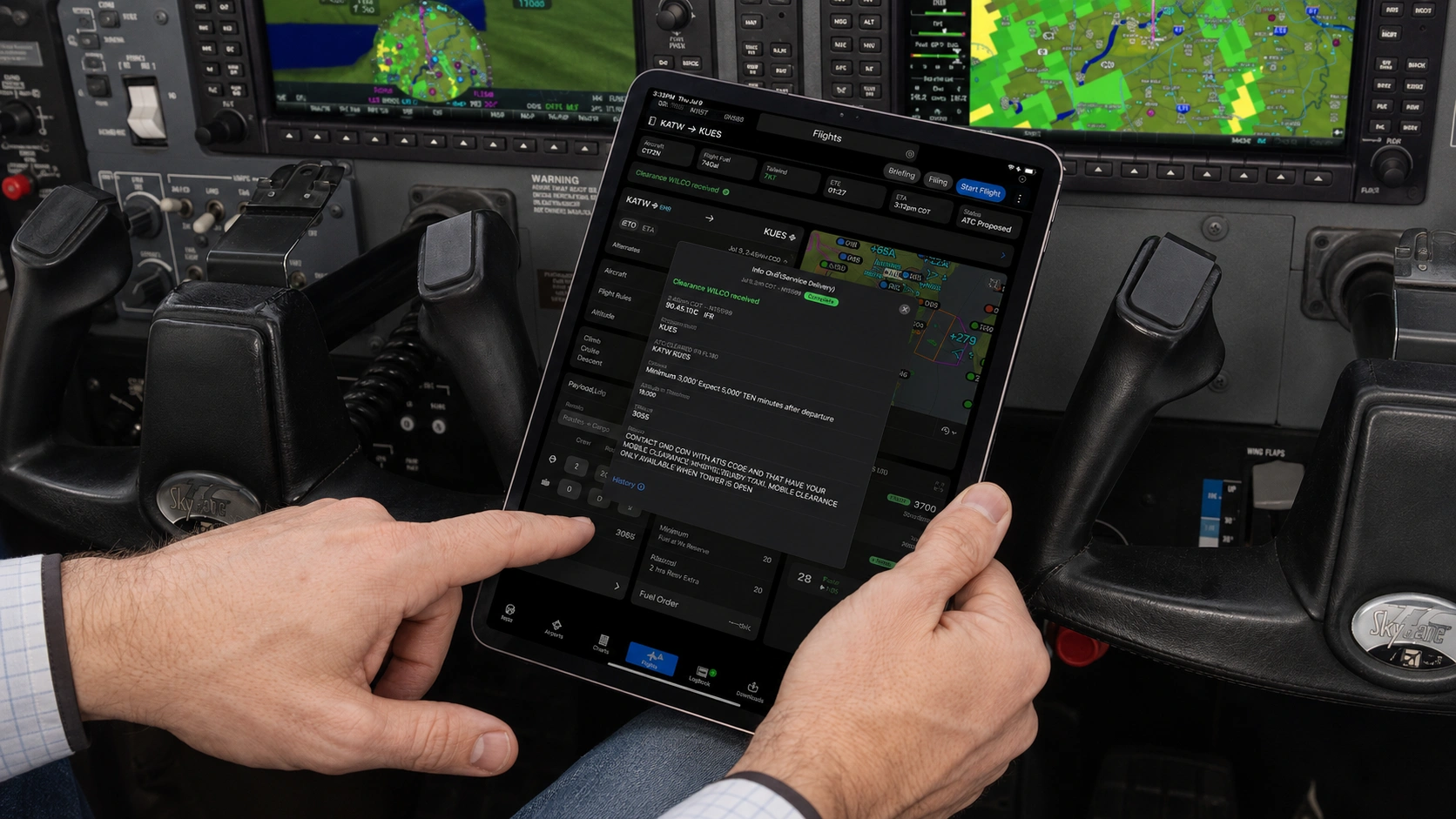
Garmin has introduced Mobile Clearance Delivery for its Garmin Pilot application, allowing eligible users at select U.S. airports to request and receive instrument flight rules (IFR) clearances directly within the app. Developed in collaboration with the Federal Aviation Administration and MITRE, the feature is currently available as part of a phased operational test and evaluation program that will expand gradually through 2028. The announcement highlights the continued digital transformation of general and business aviation, where software increasingly streamlines tasks that have traditionally relied on voice communication.
Obtaining an IFR clearance has long been a routine but time-sensitive step before departure for instrument-rated pilots. At airports without existing Pre-Departure Clearance or Data Comm services, pilots often contact air traffic control by radio or telephone to receive routing instructions before takeoff. While effective, the process can contribute to radio congestion, require lengthy readbacks, and add workload during a critical phase of flight preparation, particularly at busy airports.
Garmin’s new feature aims to simplify that exchange by providing a text-based workflow within the flight planning environment. After filing an IFR flight plan, Garmin Pilot Premium subscribers using compatible iOS devices can receive an electronic clearance, review the routing, and acknowledge it through the application before departure. The approved route can then be displayed on the app’s navigation map and, when supported by the aircraft’s equipment, transferred directly to compatible avionics. Garmin also plans to add in-app IFR cancellation after landing, a capability intended to reduce the need for additional radio or phone communication at airports where air traffic control services may be limited or unavailable during certain hours.
The rollout reflects a wider trend toward digitizing aviation operations without altering the underlying safety procedures that govern flight. Electronic documentation and integrated planning tools are increasingly helping pilots manage information more efficiently while reducing opportunities for transcription errors and easing demands on communication channels. These incremental improvements often have a meaningful impact by making established procedures more consistent and accessible.
Garmin’s Mobile Clearance Delivery initiative illustrates how aviation technology continues to evolve through collaboration between industry and government. Although the capability is currently limited to a small number of participating airports, its phased expansion suggests growing interest in modernizing routine pilot-controller interactions while preserving the procedural safeguards that remain central to instrument flight operations.