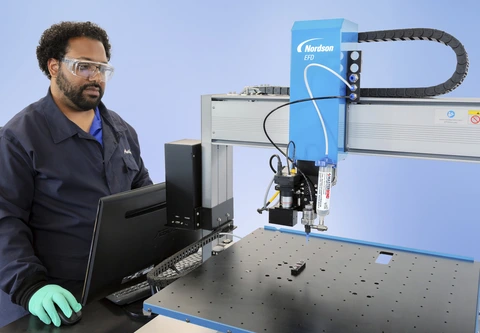
Nordson EFD’s presence at MD&M West reflects how precision fluid dispensing and automation are moving from niche tools to core enablers of safer, smaller, and more complex medical devices.
At MD&M West 2026, Nordson EFD is using the show floor to highlight a shift already underway in medical manufacturing: assembly automation is no longer optional as devices become smaller, smarter, and more integrated with electronics. Its demonstrations and technical sessions point to a growing recognition that precision at microscopic scales increasingly defines whether a medical product can be reliably manufactured at all.
The company’s live demonstrations focus on tasks that rarely attract attention outside engineering circles but are critical to patient safety and device longevity. Encapsulating wearable sensors, underfilling electronic components, and bonding needles with exacting consistency all illustrate how fluid dispensing has become a structural element of modern device design rather than a finishing step. These processes must balance protection, flexibility, and durability while operating within shrinking tolerances that manual methods struggle to meet.
This emphasis reflects broader pressures facing the medical device industry, where innovation in function often outpaces innovation in manufacturing. As devices incorporate embedded sensors, drug delivery mechanisms, and compact electronics, production teams must translate laboratory designs into repeatable, scalable processes. Automation platforms such as multi-axis dispensing systems are increasingly positioned as bridges between prototype experimentation and high-volume manufacturing.
Nordson EFD’s educational session at MD&M West reinforces this point by framing automation not as a single investment, but as a journey that spans research, design, and supply chain readiness. By examining how complex devices evolve from early concepts to industrialized products, the discussion highlights a common industry challenge: engineering breakthroughs can stall without equally sophisticated assembly strategies. The focus on real-world case studies suggests a practical acknowledgment that adoption depends on measurable outcomes, not just technical promise.
Taken together, the company’s presence at the conference signals a broader industry recalibration. Assembly automation is no longer confined to efficiency gains or cost reduction; it is becoming central to enabling new categories of medical technology. As regulatory expectations, device complexity, and patient demands continue to rise, the ability to dispense, bond, and protect materials with precision may quietly determine which innovations reach the clinic and which remain on the drawing board.