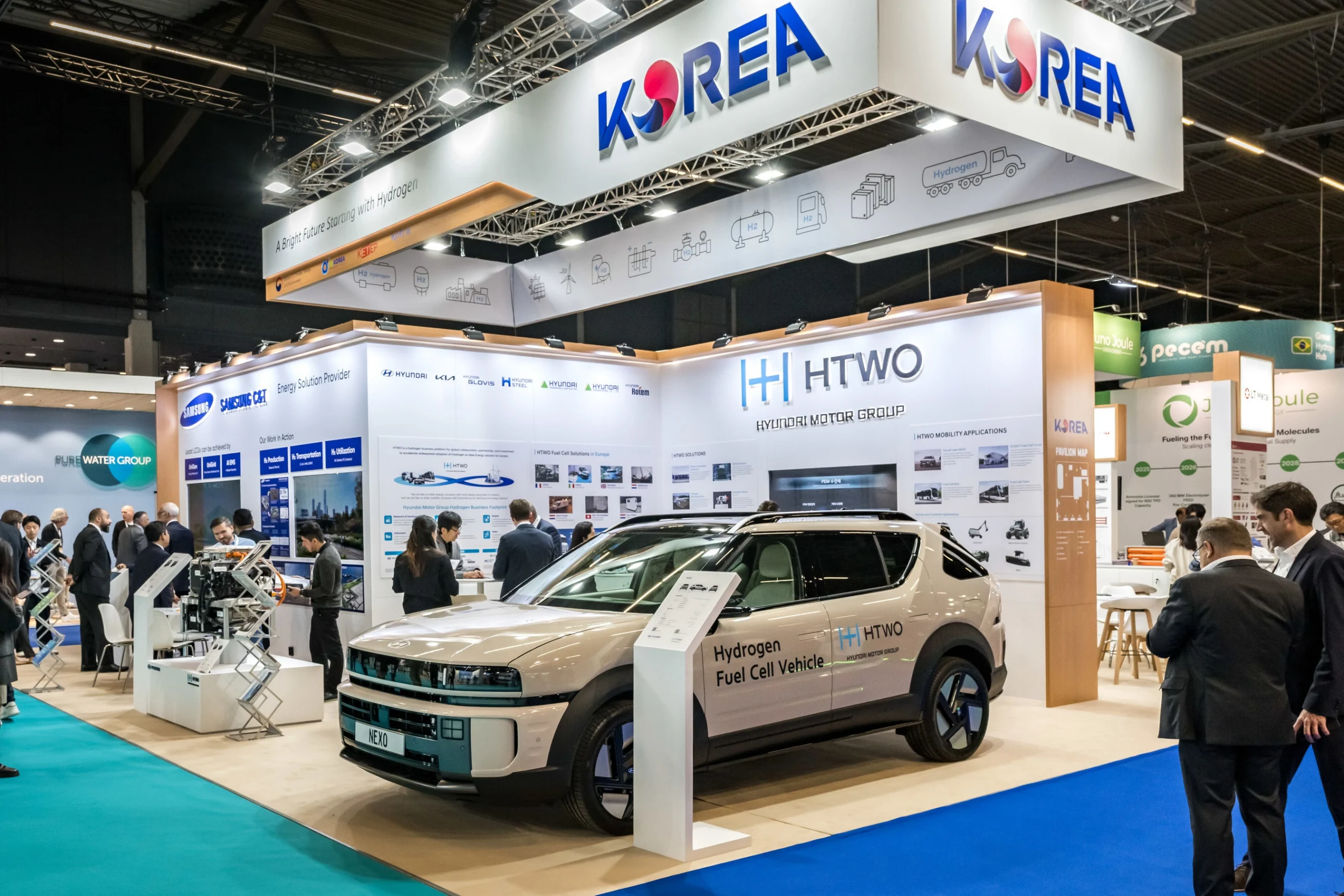
At the World Hydrogen Summit, the company outlines a broader strategy that moves beyond vehicles, positioning hydrogen as a system-wide solution tied to infrastructure, industry, and energy resilience
Hyundai Motor Group used the World Hydrogen Summit 2026 in Rotterdam to present an expanded vision for hydrogen in Europe, positioning itself not just as an automaker but as a participant in a wider energy ecosystem. The company’s showcase emphasized how its hydrogen technologies extend beyond transportation into infrastructure, power generation, and industrial use cases.
The display included the latest version of the NEXO fuel cell vehicle alongside modular hydrogen fuel cell systems designed for diverse applications. While hydrogen-powered vehicles remain a visible entry point, the broader message focused on integration—linking production, storage, and end-use into a cohesive value chain. This reflects a growing recognition that hydrogen’s viability depends less on individual products and more on coordinated system development.
Europe’s interest in hydrogen has accelerated in recent years as governments seek alternatives to fossil fuels and greater energy independence. In that context, Hyundai Motor Group’s pitch aligns with regional priorities, particularly around building resilient, low-carbon energy systems. By drawing on its experience in South Korea, where hydrogen infrastructure has seen more extensive deployment, the company is positioning itself as a partner capable of translating policy ambitions into operational models.
The emphasis on collaboration is notable, especially given the scale and complexity of hydrogen adoption. Developing a functional ecosystem requires coordination across policymakers, industrial operators, and technology providers, making partnerships as critical as technological capability. Hyundai’s approach suggests that success in this space will hinge on aligning these stakeholders rather than advancing isolated innovations.
As the energy transition unfolds, hydrogen remains both promising and uncertain, with questions around cost, efficiency, and infrastructure still unresolved. Hyundai Motor Group’s presentation underscores a broader industry shift toward system-level thinking, where the challenge is not simply proving a technology works, but ensuring it can be deployed at scale. In that sense, the company’s European strategy reflects a pragmatic acknowledgment that the future of hydrogen will depend on integration as much as invention.