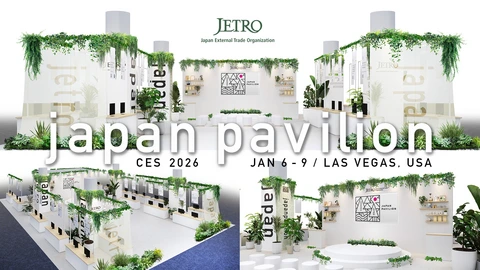
JETRO’s expanded Japan Pavilion at CES 2026 reveals a strategy focused less on spectacle and more on helping early-stage companies translate technical depth into narratives that resonate with global investors, partners, and media.
JETRO, the Japan External Trade Organization, will return to CES 2026 with a larger and more structured presence, bringing 31 Japanese startups to Eureka Park under the Japan Pavilion banner. Beyond exhibiting, JETRO plans to host pitch sessions three times a day, positioning CES not just as a showcase but as a proving ground for how Japanese startups communicate their value internationally. The approach reflects an awareness that global visibility now depends as much on storytelling as on engineering.
The pitch format itself is telling. By organizing sessions around themes such as use cases, open Q&A, and competitive pitch battles, JETRO is encouraging founders to move beyond technical explanations toward real-world applications and market relevance. This shift mirrors a broader challenge for Japan’s startup ecosystem, which has long been praised for deep technology but sometimes criticized for conservative global outreach.
CES also serves as a rare convergence point where startups can meet media, investors, and potential partners in rapid succession. JETRO’s coordination of side events—from CES Unveiled to ShowStoppers and specialized XR gatherings—suggests an effort to maximize that density of attention. Rather than relying on a single booth interaction, the pavilion’s companies are being guided into multiple forums where visibility compounds.
The decision to spotlight Japan Pavilion exhibitors that have already received CES Innovation Awards further reinforces credibility. In a crowded startup arena, third-party validation helps cut through noise, especially for companies entering unfamiliar markets. Highlighting these honorees within the pavilion frames Japan’s startup presence not as experimental, but as competitive at a global level.
More broadly, JETRO’s CES strategy points to a recalibration of how Japan supports early-stage companies abroad. The emphasis on pitching cadence, category framing, and repeated exposure suggests that success is increasingly measured by how quickly startups can adapt to global expectations. CES 2026 becomes less about individual product launches and more about training companies to operate confidently on an international stage, where clarity, speed, and relevance often matter as much as innovation itself.