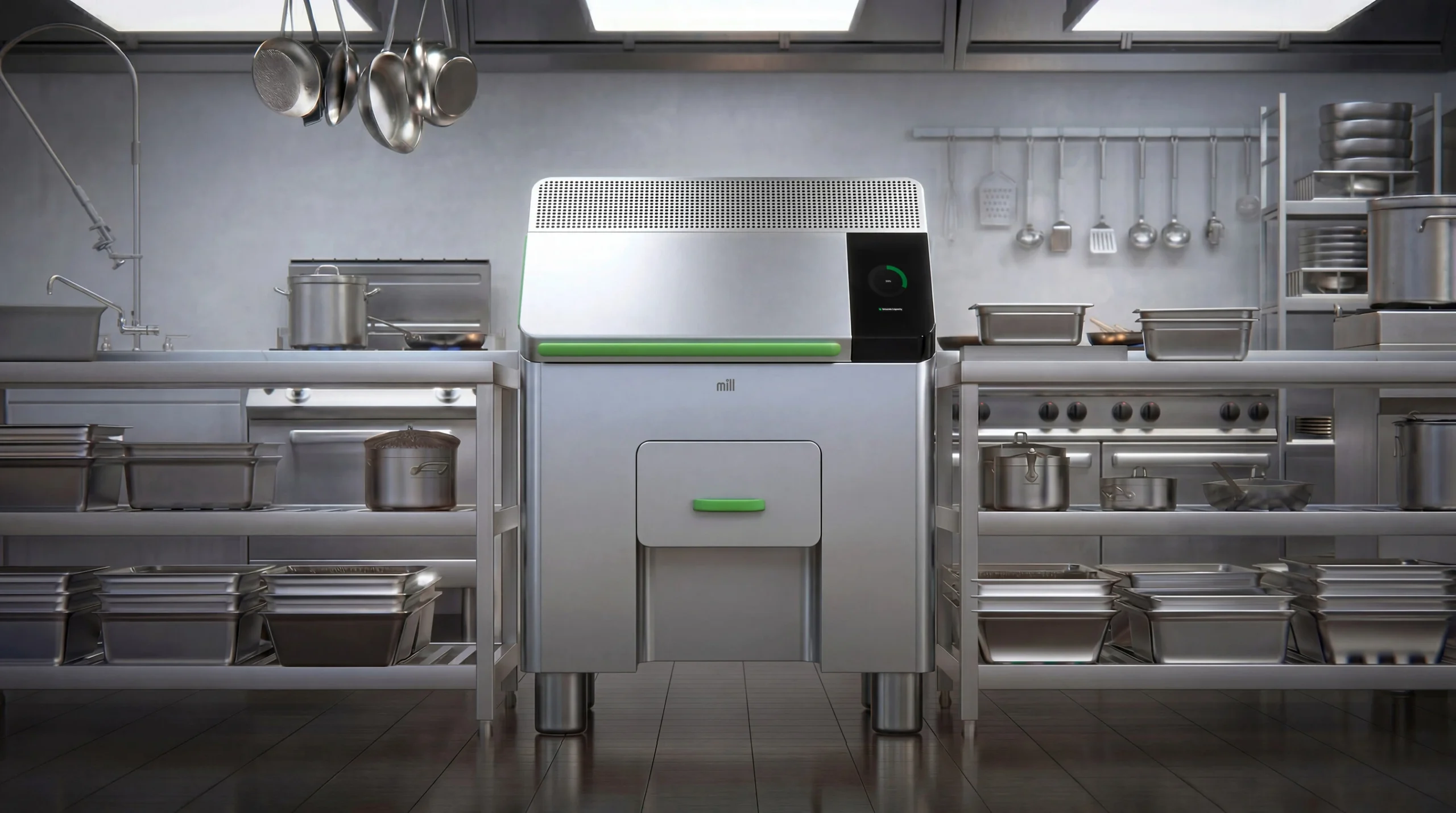
A partnership between a waste-tech startup and a major foodservice operator explores how AI and on-site processing could reshape how commercial kitchens manage surplus food
Mill Industries Inc. is partnering with Compass Group North America to address one of the food industry’s most persistent inefficiencies: waste. The agreement will see Mill’s food recycling system introduced across Compass-operated kitchens in settings ranging from corporate campuses to hospitals and stadiums, beginning in 2027.
The initiative reflects a growing recognition that food waste is not only an environmental issue but also an operational blind spot. Compass Group, which serves millions of meals daily, has set a target to halve food waste by 2030, and the partnership positions technology as a central tool in reaching that goal. Rather than treating waste as an inevitable byproduct, the approach reframes it as a measurable and potentially preventable outcome.
At the center of the collaboration is an on-site system designed to process food scraps directly within commercial kitchens. By combining heating, drying, and grinding, the system reduces waste volume significantly while producing a shelf-stable byproduct that can be reused in agricultural or industrial applications. This shift toward localized processing suggests a move away from traditional waste disposal models and toward more circular resource management.
Equally significant is the system’s use of AI to track what is being discarded and when. By analyzing waste patterns in real time, kitchen operators gain insight into purchasing decisions, menu planning, and portion control—areas where inefficiencies often go unnoticed. In theory, this data-driven feedback loop could help organizations reduce both environmental impact and operating costs, aligning sustainability goals with financial incentives.
The partnership arrives amid increasing scrutiny of global food systems, where waste accounts for a substantial share of lost economic value and environmental strain. If successful, the model could offer a blueprint for how large-scale foodservice providers rethink waste—not as an endpoint, but as a source of insight and recovery within a more closed-loop system.