The 100% Great Lakes Fish initiative’s international recognition reflects a broader shift toward circular, low-waste food systems—and raises questions about how regional industries adapt to global expectations
The 100% Great Lakes Fish initiative, led by the Great Lakes St. Lawrence Governors and Premiers, has earned a United Nations FAO award for its work promoting more complete use of the region’s fish resources. For a relatively young program, the recognition signals how sustainability efforts rooted in local industries are increasingly evaluated on a global stage. It also underscores the growing scrutiny on waste in aquatic food systems, where efficiency and ecology intersect.
The initiative was honored during the UN Food and Agriculture Organization’s 80th anniversary events and the 2025 World Food Forum in Rome, a gathering that draws policymakers, scientists, and industry leaders. That context matters: the FAO’s Blue Transformation framework emphasizes strengthening aquatic food systems as part of long-term food security strategies. Against that backdrop, the Great Lakes effort offers a regional experiment in applying circular-economy principles to fisheries.
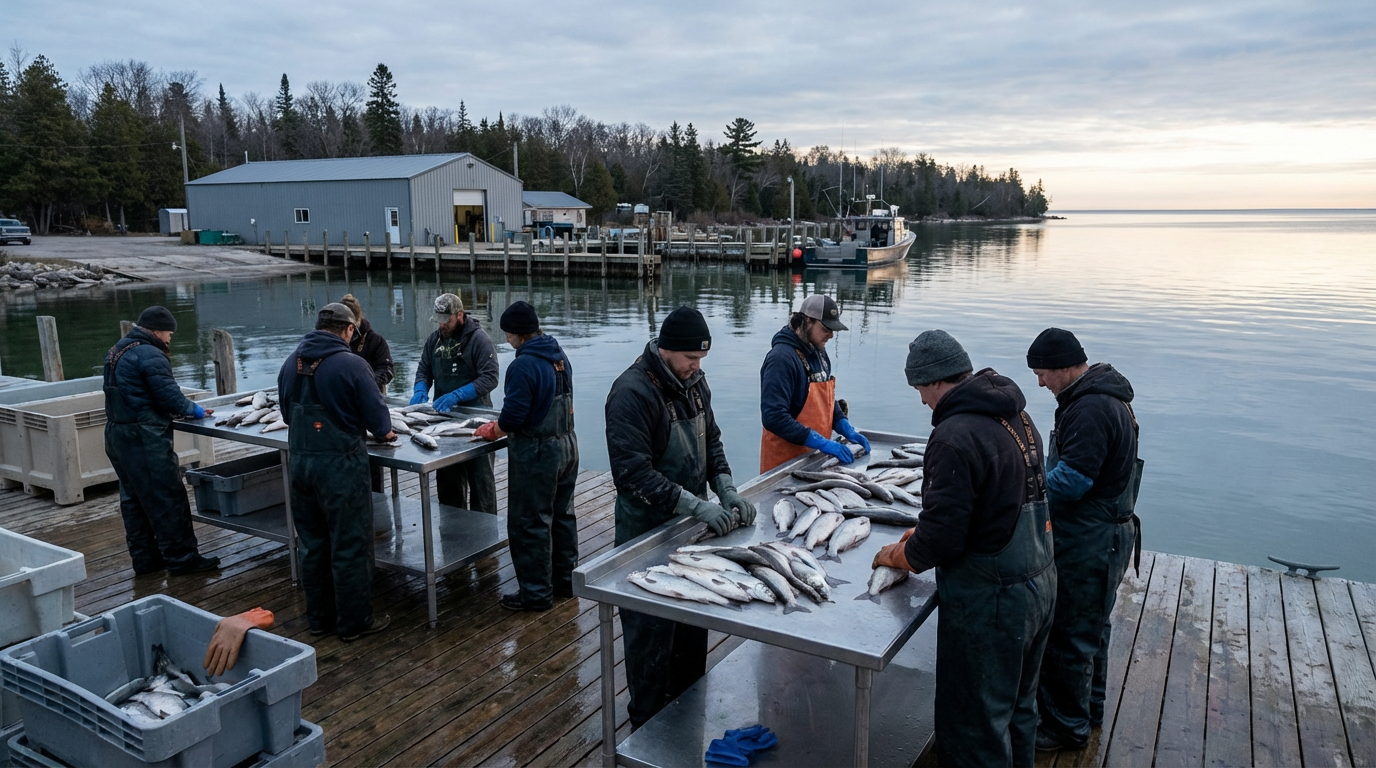
Central to the program is the 100% Great Lakes Fish Pledge, which asks commercial processors and aquaculture producers to fully use every fish they handle by the end of this year. The pledge has already attracted 44 participants representing about 90 percent of commercially caught Great Lakes fish, a scale that gives the initiative practical weight rather than purely symbolic value. Full utilization extends beyond fillets to products historically overlooked or discarded, shifting perceptions of what constitutes valuable output.
The challenge this initiative confronts is substantial: only about 40 percent of a fish—the fillets—is typically eaten, leaving the majority underused or discarded. By encouraging processors to find higher-value applications for the remaining 60 percent, the program aims to reduce waste while supporting rural economies tied to fishing and aquaculture. Iceland’s experience, often cited as a model, shows how underutilized materials can become ingredients for pharmaceuticals, cosmetics, and other specialized products.
The UN award suggests that the Great Lakes region may be positioned to join a broader global effort to modernize aquatic food systems through innovation rather than expansion. Yet the longer-term test will be whether small and mid-sized fisheries can sustain the investments and market development required for full utilization. Recognition alone does not guarantee transformation, but it does signal that the expectations for regional fisheries are changing—and that waste, once accepted as inevitable, is becoming a metric of progress.