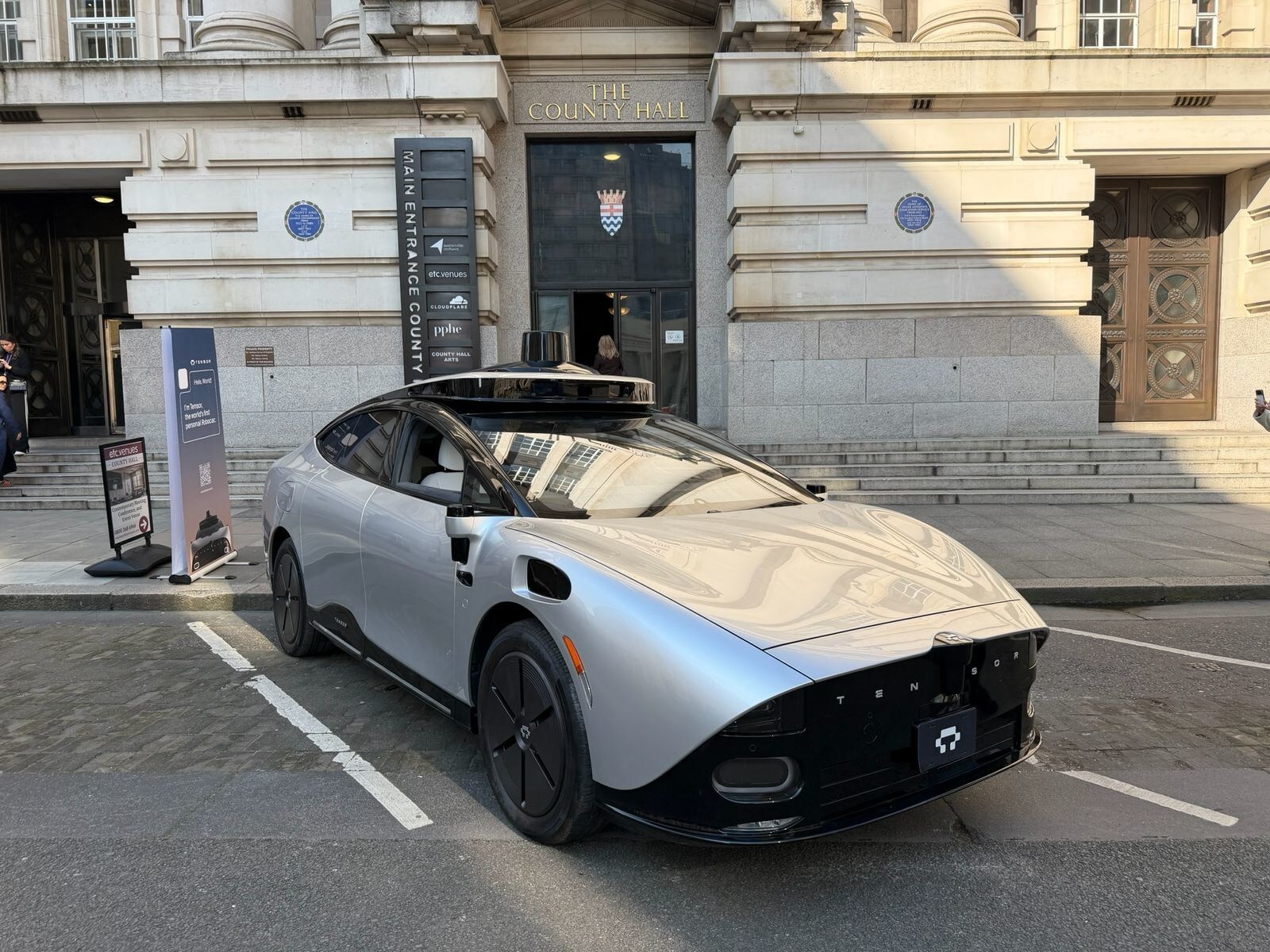
Tensor’s UK debut highlights the evolving vision of autonomous vehicles, where personal ownership and dual-mode driving challenge earlier assumptions about how self-driving technology will be deployed.
Tensor Auto unveiled its Level 4 “Robocar” in the United Kingdom at the European AV Summit, presenting what it describes as a production-ready autonomous vehicle designed for private ownership. The introduction marks a notable step in a sector that has largely focused on fleet-based services, such as ride-hailing and logistics, rather than consumer-directed models.
The vehicle is positioned around a dual-mode concept, allowing users to alternate between manual driving and fully autonomous operation. This approach reflects ongoing uncertainty in how quickly consumers and regulators will embrace fully driverless systems, suggesting that flexibility may be a key factor in broader adoption.
Tensor’s design includes features such as a foldable steering wheel and adaptive safety systems, developed in collaboration with established automotive partners. These elements point to a broader industry effort to integrate autonomy without abandoning familiar driving interfaces, easing the transition for users accustomed to traditional vehicles.
The company’s emphasis on “Level 4” capability—where the vehicle can operate independently under certain conditions—places it within a competitive but still emerging category. While several companies have demonstrated similar technologies, bringing them to market for personal ownership introduces new challenges around regulation, insurance, and public trust.
The European AV Summit provided a setting that extends beyond technology demonstration, bringing together policymakers, insurers, and infrastructure planners. Tensor’s participation underscores how the future of autonomous vehicles is shaped not only by engineering advances but also by the frameworks that govern their use in real-world environments.
By targeting markets in Europe, the Middle East, and the United States, the company is positioning itself for a global rollout, though timelines for widespread adoption remain uncertain. Regional differences in regulation and infrastructure are likely to influence how quickly such vehicles move from demonstration to everyday use.
Tensor’s announcement reflects a broader recalibration within the autonomous vehicle industry. Rather than focusing solely on replacing drivers, companies are exploring hybrid models that preserve user control while gradually introducing automation.
In that sense, the Robocar represents both a technological milestone and a strategic bet. Its success may depend less on the sophistication of its systems and more on whether consumers are ready to rethink the role of driving itself in an increasingly automated world.