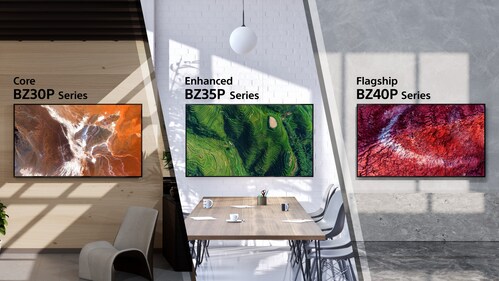
With its redesigned BZ-P Series, Sony signals how professional displays are evolving beyond brightness and size, toward quieter efficiency, flexible installation, and sustained performance in everyday public environments.
When Sony Electronics unveiled its new BRAVIA Professional Displays BZ-P Series, the announcement quietly underscored a larger change in how screens function across public and commercial spaces. These displays are no longer just about delivering sharp images; they are becoming long-term infrastructure, expected to work reliably in offices, classrooms, retail floors, and transit hubs under constant use. Sony’s redesign reflects that reality, emphasizing visibility, efficiency, and adaptability rather than headline-grabbing specs.
The BZ-P lineup spans 16 models from 43 to 85 inches, but the real story lies in how the displays are engineered to perform in challenging environments. Deep Black Non-Glare technology and moderate brightness levels are aimed at clarity in bright, open spaces where reflections often undermine image quality. This focus suggests that legibility and consistency now matter more than raw luminance alone, especially as displays increasingly support information rather than spectacle.
Installation and integration also take center stage in the new series. Thinner profiles, standardized chassis designs, and updated mounting options respond to the realities faced by system integrators managing large fleets of screens. As organizations scale digital signage across campuses or transportation networks, ease of deployment and maintenance becomes a decisive factor, not a secondary consideration.
Operational efficiency is another theme woven through the update. By relying on built-in processing rather than external hardware, the displays reduce system complexity while supporting centralized management and monitoring. In practice, this reflects how professional screens are expected to run continuously with minimal intervention, blending into the background while delivering dependable performance.
Perhaps most telling is Sony’s attention to energy use and materials. Lower power consumption, recycled plastics, and onboard tools to track energy impact point to sustainability becoming a practical requirement rather than a branding exercise. As organizations face tighter energy standards and longer replacement cycles, displays that balance performance with efficiency are increasingly aligned with procurement realities. In that sense, the BZ-P Series is less about reinvention and more about maturation, marking how professional displays are settling into their role as durable, quietly efficient fixtures of modern public life.