
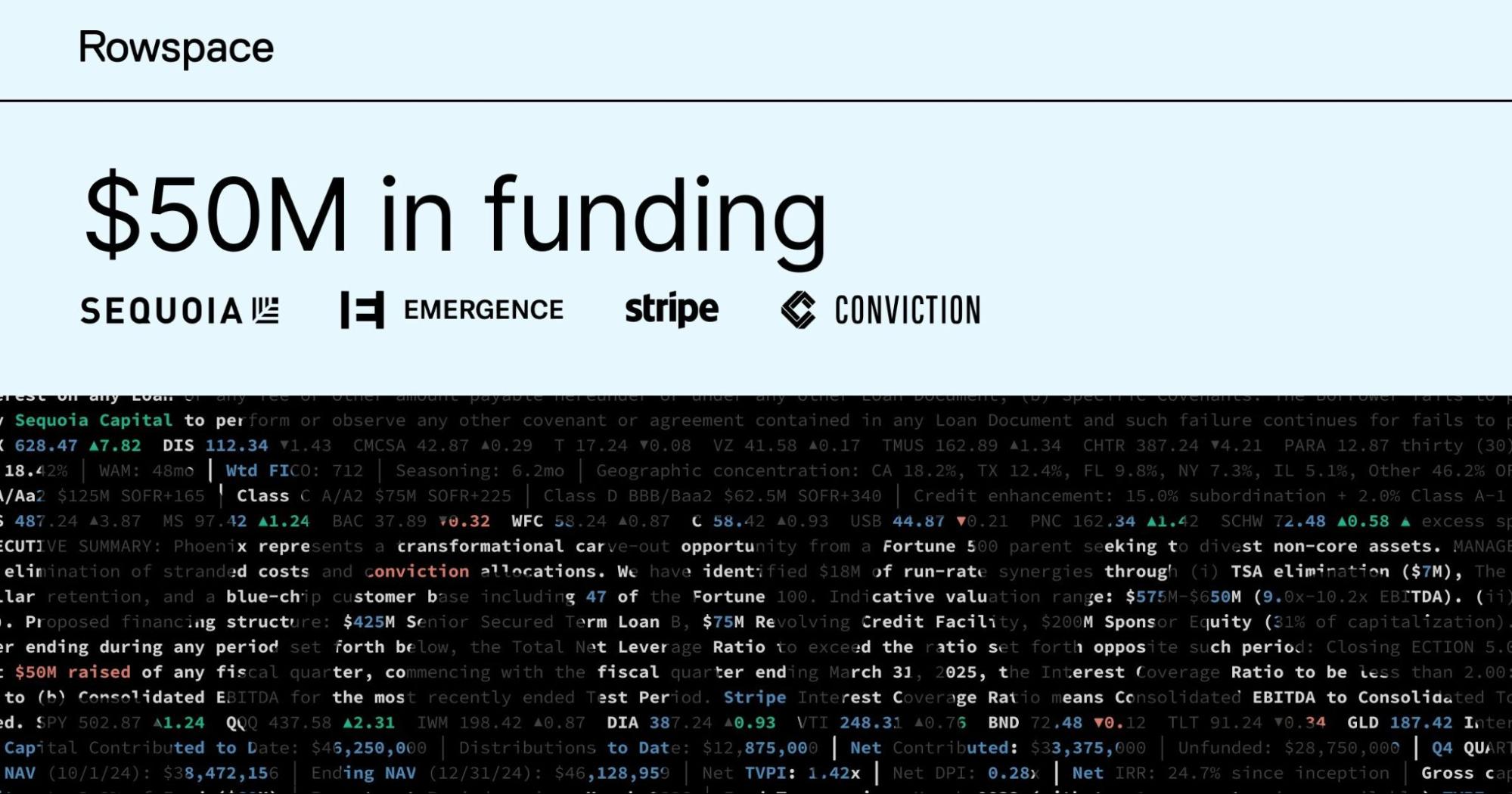
Backed by Sequoia and Emergence Capital, the new platform aims to help investment firms turn decades of proprietary data and institutional judgment into AI-driven decision support.
Rowspace emerged from stealth this week with $50 million in seed and Series A funding, positioning itself as an artificial intelligence platform tailored to financial services firms. The San Francisco–based company, backed by investors including Sequoia and Emergence Capital, says it is focused on a challenge that has long defined the industry: how to convert decades of accumulated insight into something usable at scale.
Investment firms generate vast archives of information—deal memos, credit analyses, emails, portfolio models—yet much of that knowledge remains siloed across legacy systems. Experienced partners and analysts develop pattern recognition over time, but their judgment often lives in scattered documents and individual workflows. Rowspace is built to connect structured and unstructured data across a firm’s history and apply what it describes as a “finance-native” lens to interpret it.
The company’s founders, Michael Manapat and Yibo Ling, bring experience from both technology and finance. Manapat previously worked on large-scale machine learning systems at Stripe and Notion, while Ling served as a chief financial officer and investor. Their pitch reflects a growing recognition that generic AI tools may struggle with the precision and compliance demands of institutional finance.
Rowspace deploys directly within customer environments, a design choice intended to address concerns about data control and confidentiality. Firms managing hundreds of billions in assets are already using the platform for tasks such as portfolio monitoring and historical deal analysis, according to the company. In a sector where decision speed can conflict with analytical depth, the goal is to narrow that tradeoff.
The launch comes amid an industry-wide effort to integrate AI into high-stakes workflows without sacrificing rigor. If successful, platforms like Rowspace could shift how institutional knowledge is preserved and applied—allowing firms not merely to store information, but to continuously refine and compound it as a competitive asset.