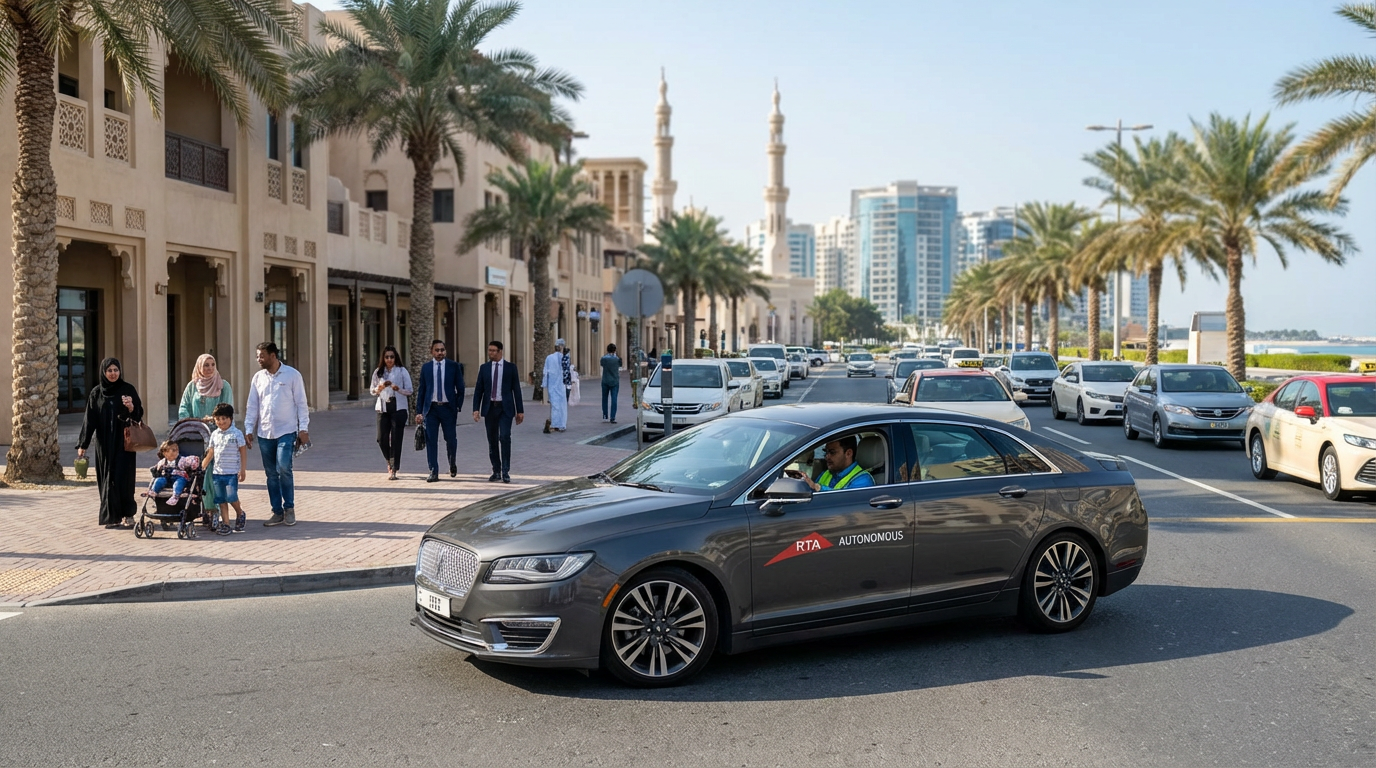
WeRide and Uber’s limited launch in tourist districts shows how regulation, public trust, and ride-hailing platforms are converging to turn autonomous vehicles from pilots into daily transport.
WeRide and Uber have taken a notable step toward normalizing autonomous transport by launching robotaxi rides in Dubai through the Uber app, marking one of the most visible public deployments of the technology to date. Rather than a closed demonstration, the service is open to everyday riders in parts of Jumeirah and Umm Suqeim, embedding autonomous vehicles directly into an existing mobility platform. The move signals a shift from experimental trials toward cautious public integration.
What distinguishes the Dubai launch is the degree of institutional alignment behind it. The service operates in partnership with Dubai’s Roads and Transport Authority and supports the city’s stated goal of making a quarter of all journeys autonomous by 2030, linking technological ambition to long-term urban planning. By situating the rollout within popular, high-traffic districts, the city is testing not only vehicle performance but also public comfort with automation in visible, everyday settings.
The current presence of a vehicle specialist onboard underscores how incremental this transition remains. Autonomous systems may be capable of navigation, but trust, safety validation, and regulatory confidence still require human oversight during early stages. This hybrid model reflects a broader pattern in the autonomous vehicle industry, where progress is measured less by technological leaps than by carefully managed handoffs from human control to software.
Dubai’s appeal as a testbed is also structural. Rapid population growth, rising demand for ride-hailing, and centralized transport governance make it easier to coordinate infrastructure, policy, and fleet operations than in many Western cities. For companies like WeRide and Uber, success in such an environment offers proof that autonomy can scale when regulatory frameworks and urban strategy are aligned rather than adversarial.
The broader implications extend beyond the UAE. By placing robotaxis inside a familiar consumer interface, the launch reframes autonomy as a service rather than a spectacle, potentially reshaping public expectations in other markets. Whether this model can translate to cities with more fragmented regulation remains uncertain, but Dubai’s experiment suggests that the path to autonomous mobility will be paved as much by governance and trust as by algorithms and sensors.