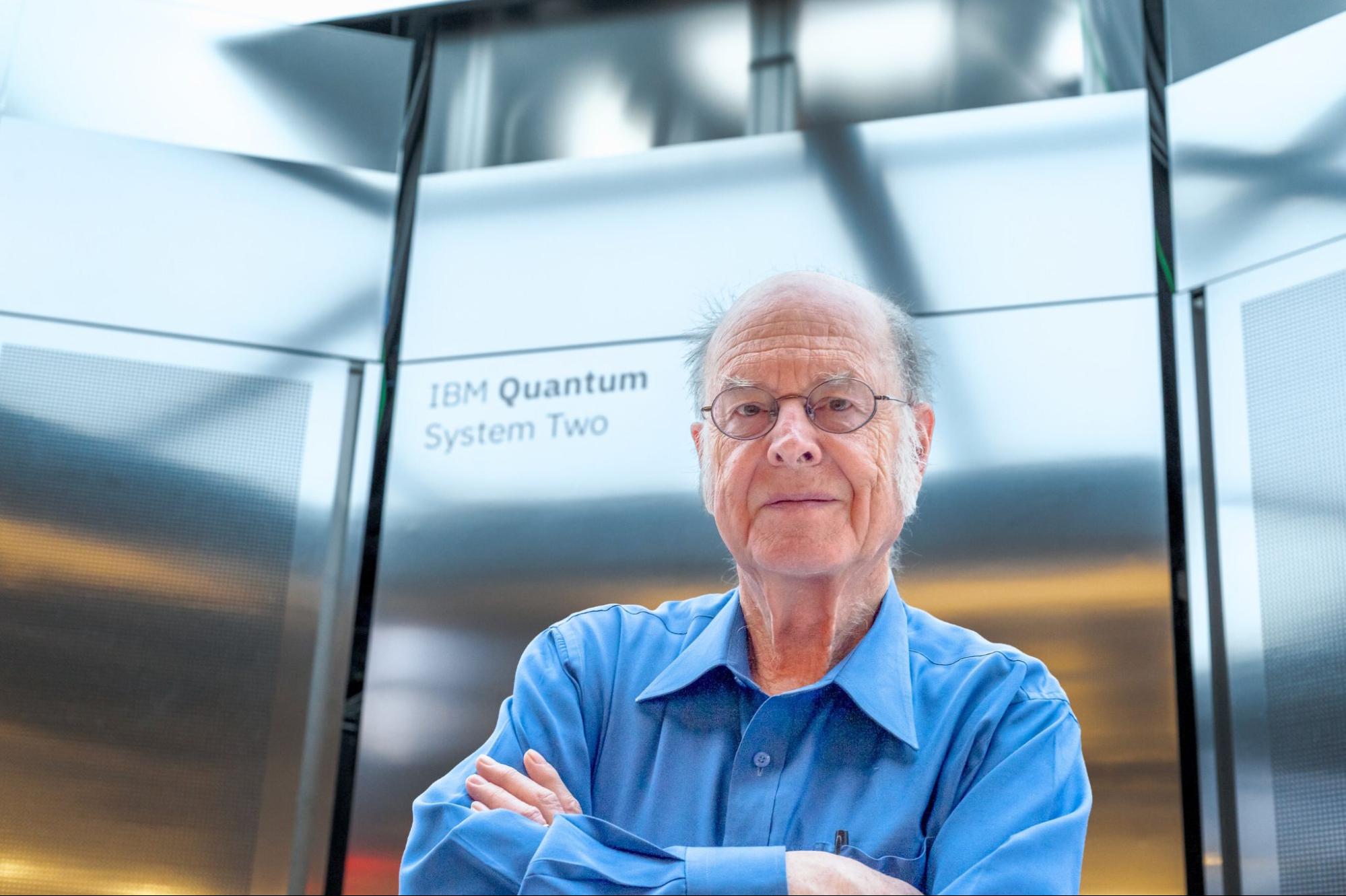
IBM researcher Charles H. Bennett receives computing’s highest honor, recognizing decades of work that helped transform quantum theory into a foundation for modern information science and emerging technologies.
IBM has announced that Charles H. Bennett, a longtime researcher at IBM Research, has been awarded the 2025 A.M. Turing Award, widely regarded as the highest distinction in computing. The recognition, shared with collaborator Gilles Brassard, reflects foundational contributions that helped establish quantum information science as a distinct field.
Bennett’s work spans more than five decades and centers on a question that once seemed largely theoretical: how the laws of physics shape the nature of information. At a time when computing was dominated by classical models, his research explored how quantum mechanics could enable entirely new ways of processing and transmitting data.
Among his most influential contributions is the development of quantum cryptography, including the early BB84 protocol, which demonstrated that secure communication could be grounded in physical principles rather than computational assumptions. He also co-authored research on quantum teleportation, showing how quantum states could be transmitted using entanglement, a concept that has since become central to quantum computing research.
These ideas, initially abstract, have gradually moved toward practical application as advances in hardware and experimental techniques have made quantum systems more viable. The field Bennett helped define now underpins ongoing efforts to build quantum computers capable of solving problems beyond the reach of classical machines.
His career also reflects the importance of interdisciplinary thinking in scientific progress. Drawing from physics, computer science, and mathematics, Bennett contributed to a shift in how researchers conceptualize computation itself—not merely as an abstract process, but as something fundamentally tied to the physical world.
The award highlights a broader moment for quantum research, which has transitioned from theoretical exploration to a major area of investment for governments and technology companies. Efforts to develop scalable, fault-tolerant quantum systems are accelerating, with potential applications ranging from cryptography to materials science.
Bennett’s recognition underscores how foundational research can shape entire fields decades later. While the technologies his work enabled are still evolving, the principles he helped establish continue to guide one of the most ambitious frontiers in computing today.
In honoring Bennett, the Turing Award also marks a milestone for quantum information science itself. Once a niche area of inquiry, it is now central to discussions about the future of computation, illustrating how long-term curiosity-driven research can eventually redefine technological possibility.