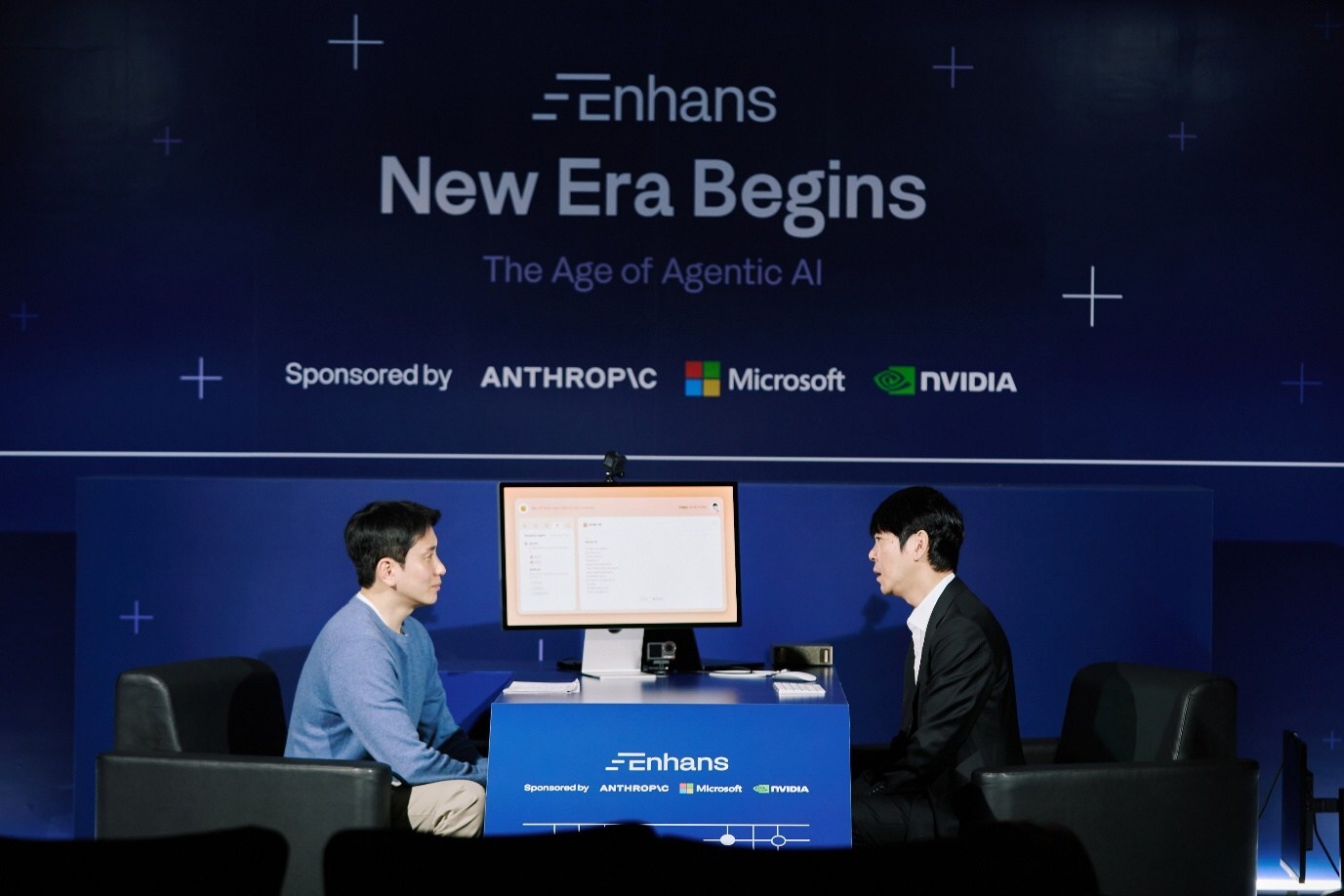
At a Seoul event marking ten years since the historic AlphaGo match, Enhans demonstrated a new generation of “agentic AI” systems designed to work alongside humans rather than compete with them.
Enhans used the tenth anniversary of the famous AlphaGo match to stage a symbolic return for Go grandmaster Lee Sedol, this time not as an opponent of artificial intelligence but as a collaborator. At an event in Seoul, the company introduced its multi-agent AI operating system while Lee demonstrated how the technology could assist with complex tasks through voice commands and automated workflows.
The setting carried historical weight. In 2016, Lee Sedol faced DeepMind’s AlphaGo at the same venue, a match widely viewed as a turning point in the public understanding of artificial intelligence. The series illustrated how machine learning systems could outperform even the world’s best players in highly strategic games, raising both excitement and concern about the future of human expertise.
A decade later, Enhans framed the narrative differently. Instead of emphasizing competition between humans and machines, the demonstration focused on collaboration, with Lee interacting with the company’s AI agents to reconstruct a Go model and then compete against the newly generated system.
The technology showcased by Enhans relies on what developers call a multi-agent architecture. Rather than depending on a single large model, the system distributes tasks among specialized AI agents responsible for planning, information gathering, coding, and execution, allowing the platform to carry out more complex workflows autonomously.
In practical terms, this approach aims to move artificial intelligence beyond conversation and into direct action. A request such as researching competitors or producing a detailed comparison report can trigger a coordinated chain of processes, with individual agents retrieving data, analyzing information, and generating outputs without manual intervention.
Such systems are often described as “agentic AI,” a concept gaining traction in the technology industry as companies explore ways to turn AI models into tools capable of performing multi-step tasks in real software environments. The goal is not simply to generate answers but to execute work on behalf of users.
The demonstration also reflected a broader cultural shift in how artificial intelligence is discussed. Early breakthroughs like AlphaGo captured attention because they showed machines outperforming humans, but many researchers now focus on how AI might extend human capabilities rather than replace them.
Enhans, founded in 2021, has been developing platforms designed to automate business workflows through combinations of reasoning systems and task-executing agents. Its technology is already integrated into a commerce platform and continues to evolve through research partnerships and industry collaborations.
By revisiting the stage where AlphaGo once challenged a human champion, the company attempted to illustrate how the conversation around AI has changed in just ten years. What was once seen primarily as a contest between human and machine is increasingly framed as a partnership shaped by shared capabilities.