Their year-long smoothie collaboration leans into personalized health data and metabolic markers, reflecting a growing pushback against one-size-fits-all “clean eating” claims.
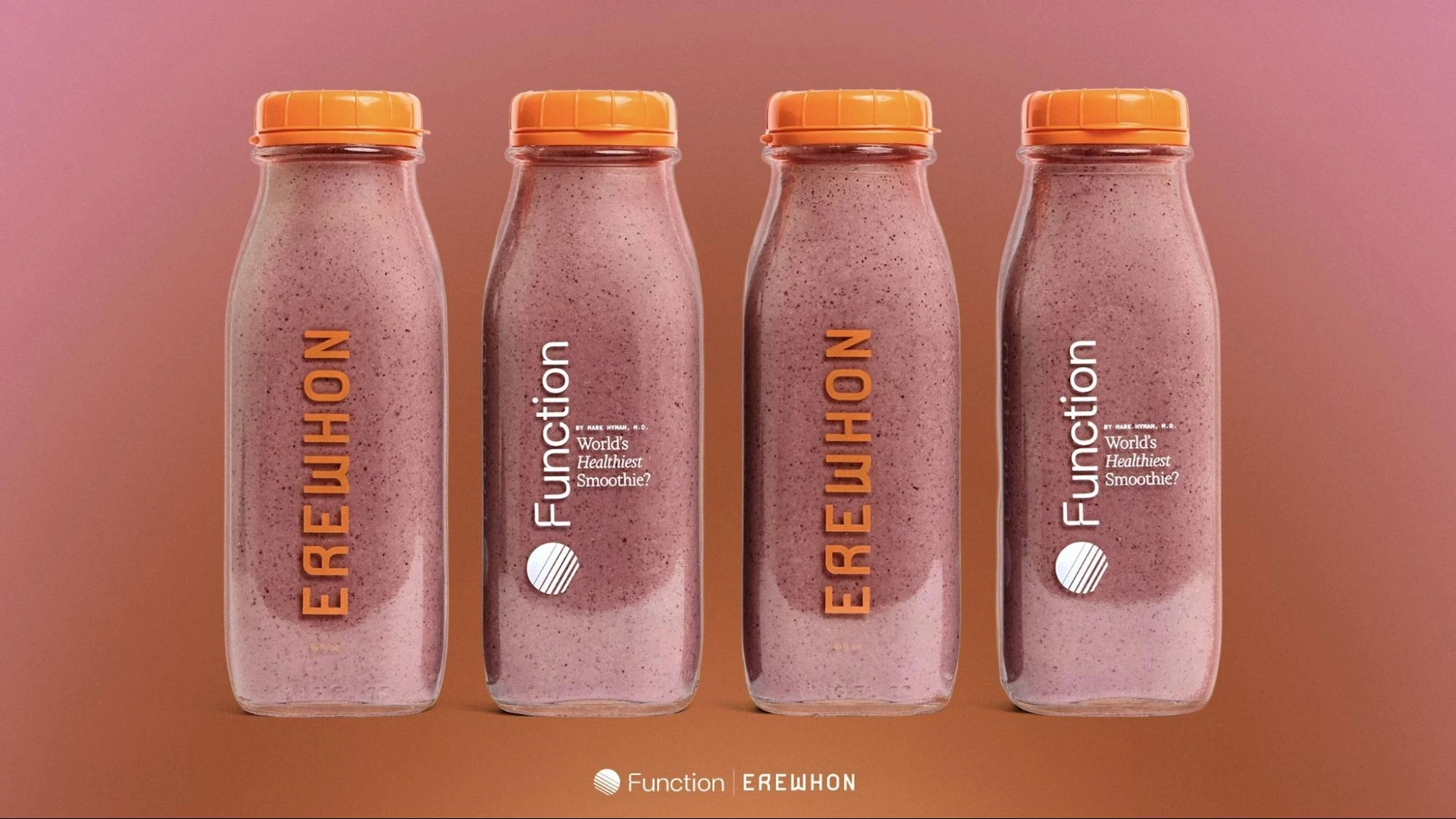
Function Health and Erewhon have launched a bottled smoothie with an unusually provocative name: “The World’s Healthiest Smoothie?” The punctuation is the point. Rather than presenting the drink as a definitive answer, the collaboration frames it as a challenge to the wellness industry’s habit of turning “healthy” into a universal label that often ignores individual biology.
The smoothie is now available in all Erewhon stores and will remain on shelves through February 2027, signaling a longer-term bet than the typical celebrity-style wellness drop. Each bottle includes a QR hang tag offering $25 off a Function membership, tying the product directly to the company’s business model: selling consumers access to 160+ lab tests and longitudinal health insights. In effect, the smoothie becomes both a consumer item and a gateway into a growing market built around biomarker-driven self-optimization.
According to the announcement, the recipe was developed using health gaps observed across Function’s membership base, particularly around metabolic and cardiovascular indicators. The company cites that more than 65% of members fall outside the optimal range for fasting insulin, and 54% show elevated Apolipoprotein B (ApoB), a marker associated with cardiovascular risk. Those statistics are used to justify a formulation built around 20 ingredients intended to support systems like inflammation balance, blood sugar stability, microbiome health, and metabolic and cellular function.
The ingredient list reads like a curated inventory of contemporary wellness logic: unsweetened almond milk, flaxseed, chia, green banana, wild blueberries, pomegranate, cranberry, arugula, herbs, walnuts, beet juice, ginger, Ceylon cinnamon, MCT oil, blended omega oils, BCAAs, creatine, and plant protein derived from chocho beans grown in the Andes. Function describes the smoothie as designed to function as a complete meal, suggesting it is meant less as a treat and more as a structured nutritional intervention.
What makes the launch culturally interesting is not the drink itself, but the framing. Wellness marketing has long relied on clean-eating shorthand—superfoods, detox language, and vague promises of “boosting” the body. Here, Function and Erewhon are instead selling skepticism, asking consumers to consider that the healthiest choice might depend on lab results rather than trend cycles.
In a crowded health-food economy, the smoothie’s most strategic ingredient may be uncertainty. By questioning the very definition of “healthy,” the collaboration reflects a shift toward personalization as the new status symbol—and toward data as the new authority.