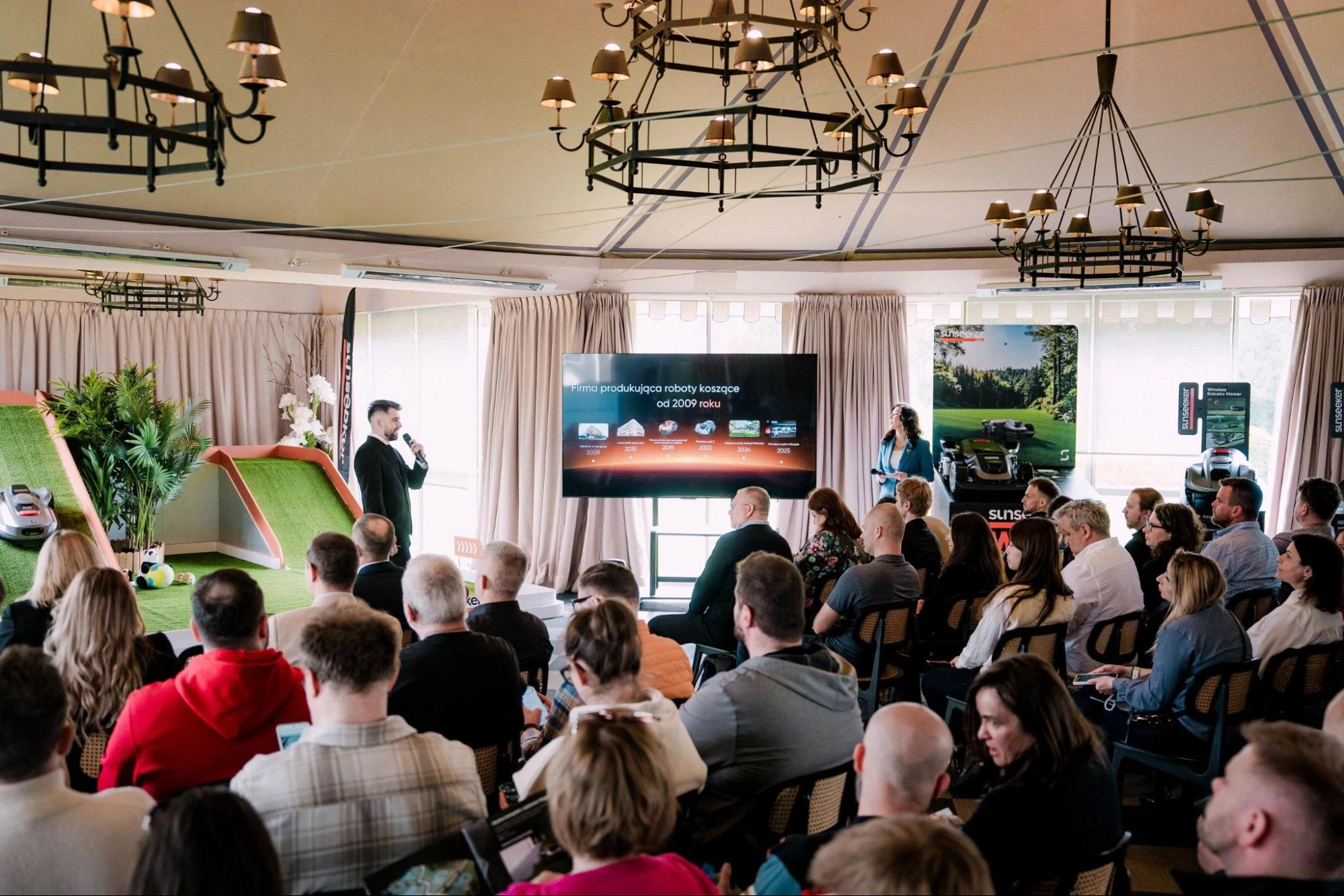
Sunseeker Robotics’ latest product showcase reflects how advances in AI, navigation, and automation are reshaping even routine household tasks like lawn maintenance.
Sunseeker Robotics introduced its X Gen 2 robotic lawn mower series in Warsaw, positioning the technology as part of a broader shift toward more autonomous, precision-driven home tools. Demonstrated alongside existing models, the new lineup highlights how garden equipment is evolving from simple automation to systems capable of adapting to complex, real-world environments.
At the core of the new series is an upgraded navigation framework that combines satellite-based positioning with visual mapping technologies. By integrating network-based RTK and visual SLAM, the system aims to deliver centimeter-level accuracy without the need for boundary wires, a limitation that has traditionally constrained robotic mowers. This approach reflects a wider trend in robotics, where hybrid sensing methods are increasingly used to improve reliability in unpredictable outdoor settings.
The addition of enhanced computing power and vision-based AI also points to a growing emphasis on real-time decision-making. Features such as obstacle detection, narrow-path navigation, and night operation suggest that these machines are being designed not just to follow pre-set routes, but to interpret and respond to their surroundings dynamically. In practical terms, this reduces the need for user intervention, moving closer to the goal of fully autonomous maintenance.
Equally notable is the focus on terrain adaptability. With systems designed to handle steep slopes and uneven surfaces, the technology addresses one of the longstanding challenges in robotic lawn care. By combining mechanical engineering with software-driven control, the machines aim to operate effectively across a wider range of residential and semi-professional environments.
The broader significance of these developments lies in how they redefine expectations for everyday automation. Lawn care, once a manual or semi-assisted task, is becoming part of a larger ecosystem of smart home technologies that prioritize convenience, efficiency, and minimal oversight. As these systems become more capable, they also raise questions about how much routine labor will be delegated to autonomous machines.
Sunseeker’s latest launch illustrates how incremental improvements in sensing, processing, and design can collectively transform a familiar category. Rather than introducing entirely new functions, the emphasis is on refining existing ones to the point where automation feels seamless, reliable, and increasingly invisible in daily life.